
How to Build a Facebook Ads Funnel That Actually Converts
Many businesses run Facebook ads, see the likes, comments, and clicks come in, and then wonder why so few of those people become qualified leads or customers. The attention is there. The results are not.
Often the issue is that one ad is being asked to do every job at once. People rarely buy from a brand the first moment they hear about it. Someone discovering an unfamiliar service needs different information from someone who has already visited your pricing page or left a product in their cart.
A Facebook ads funnel solves this by matching your advertising message to where each prospect is in their decision.
Building a Facebook ads funnel means defining your business goal and offer, introducing the offer to relevant people, giving interested prospects the information they need, encouraging a clear conversion, following up appropriately, and measuring what happens across the whole customer journey.
This guide walks through each of those steps, from planning and campaign structure to tracking and optimization, and shows how to keep the funnel as simple as your business and budget allow.
What Is a Facebook Ads Funnel?
A Facebook ads funnel is a structured approach to advertising that guides prospective customers from first discovery toward a desired action, such as submitting a lead form, making a purchase, booking an appointment, or requesting a demo. It applies to Facebook and Instagram advertising alike, since both are managed through Meta Ads Manager.
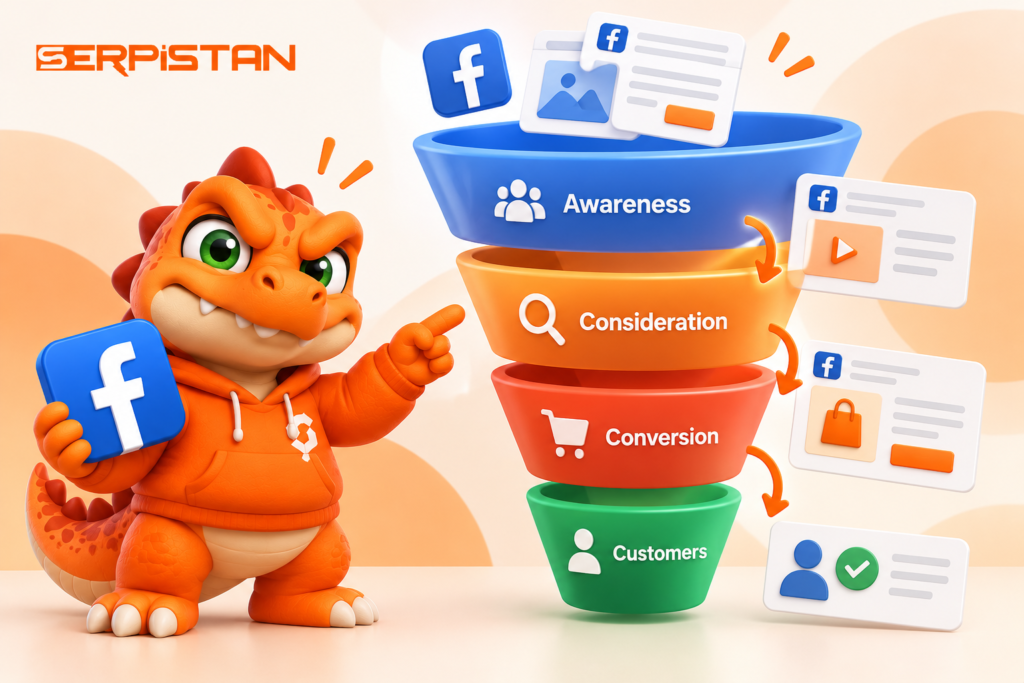
Most funnels are planned around four stages:
- Awareness: introduce the brand, problem, product, or service to relevant people who may not know you yet.
- Consideration: help interested prospects understand the offer, compare options, and build confidence.
- Conversion: encourage people who are ready to act to complete the desired action.
- Retention and re-engagement: where it fits the business, encourage repeat purchases, continued use, or another relevant next step.
These stages are a planning model, not a fixed path. Some people convert after a single ad; others need weeks of research. The funnel simply helps you make sure each type of prospect sees a message that suits them.
Advertising is also only one part of the journey. A complete Facebook marketing funnel usually includes landing pages, website content, lead forms, email follow-up, and, for many businesses, a sales conversation.
Define Your Goal, Audience, and Offer
A funnel should start with a specific business objective, not with a campaign format you have seen someone else use.
Choose one primary conversion goal
Pick the single action that matters most right now. For example:
- Generating qualified enquiries for a service business.
- Collecting demo requests for a B2B company.
- Driving online purchases for an ecommerce store.
- Encouraging trial signups for a software product.
- Booking consultations for a professional service.
This goal shapes everything that follows: the campaign objective you choose, where you send people, and the metrics you use to judge success.
Understand your ideal customer
Before writing a single ad, be clear on:
- The main problem or need your audience has.
- The circumstances that make your offer relevant (a new business, a seasonal need, a regulatory change).
- The questions and objections people raise before buying.
- The factors that influence their decision, such as price, speed, trust, or convenience.
- Any geographic or eligibility constraints.
- What separates a qualified prospect from someone who is simply curious.
Use real evidence wherever you can: customer feedback, sales conversations, website analytics, and existing customer data. Assumptions are a starting point, not a strategy.
Create an offer worth acting on
An effective funnel needs a relevant, compelling offer. Depending on the business, that might be a useful guide, a free consultation, a product demonstration, a trial, an introductory offer, or simply the product itself.
Do not create a lead magnet or discount just because it is common practice. A free checklist that attracts students will not help a firm selling to finance directors. The offer should attract the right people and lead naturally to what you actually sell.
Practical takeaway: before launching, write down five things: the target audience, the problem you solve, the offer, the primary conversion action, and how you will measure success.
Build the Awareness Stage
The awareness stage introduces your business to relevant people who may not know your brand, or may not yet realize there is a good solution to their problem.
Choose the right message and creative
Good awareness creative earns attention and shows relevance without pushing a hard sell on people who have never heard of you. Options include:
- Short videos that show a problem or how it gets solved.
- Clear static images that communicate one key benefit.
- Educational content that explains a common challenge.
- Product demonstrations.
- Genuine customer stories or testimonials, where you have them and have permission to use them.
Keep the message focused. A new audience will remember one clear idea, not five.
Choose an appropriate campaign objective
The campaign objective tells Meta’s delivery system what result to look for. A business that mainly wants to be seen by a relevant audience might choose an awareness objective. A business that wants website visits or measurable leads should consider objectives designed for those outcomes, such as traffic, engagement, or leads.
Objective names and options in Meta Ads Manager change from time to time, so check the current choices in your account when you set up the campaign.
An awareness campaign does not always need to send people to a website. A video that people watch in the feed can do its job without a click, and the people who watch can later be reached with consideration-stage ads.
Measure awareness correctly
Useful awareness indicators include reach (how many people saw the ad), impressions (how many times it was shown), frequency (the average number of times each person saw it), video engagement, and relevant later activity where you can measure it.
These metrics tell you about exposure and interest. They do not tell you about purchase intent or profitability, so do not judge an awareness campaign by sales alone, and do not treat high engagement as proof that people want to buy.
Illustrative example: a software startup could run a 30-second demonstration video showing the frustrating manual task its product removes, then show more detailed product information only to people who watched a meaningful portion of the video.
Build the Consideration Stage
The consideration stage helps people who have shown some interest understand your offer and decide whether it suits them.
Address the questions prospects need answered
Consideration-stage creative should add new information, not repeat the awareness message. It might explain:
- How the product or service works.
- Which specific problem it solves.
- How it differs from alternatives, including doing nothing.
- What the buying or signup process involves.
- How you handle common objections or concerns, such as price, setup time, or contract length.
- What genuine evidence supports your claims, such as reviews, case studies, or certifications.
Formats such as carousels, longer videos, short explainer pages, and FAQ-style ads work well here because they give people room to learn.
Use retargeting where it makes sense
Retargeting means showing ads to people who have already interacted with your business. In Meta Ads Manager this is typically done with custom audiences, for example people who watched your videos, engaged with your Facebook or Instagram profile, or visited your website. Meta’s documentation on website custom audiences explains that website-based audiences rely on the Meta Pixel (and can also use Conversions API events), and that an audience can only be targeted once it reaches a certain size.
That last point matters for smaller businesses. Not every interaction produces a usable audience, and a site with modest traffic may not support several separate retargeting campaigns. Availability also depends on current platform capabilities, consent choices, and privacy rules in your market.
A Facebook retargeting funnel should be helpful, not relentless. Avoid bombarding every visitor with multiple ads the moment they leave your site; instead, show people the information they are most likely to need next.
Send prospects to a relevant destination
Depending on the offer, that might be a focused landing page, a product or service page, a comparison resource, or a lead form. Whatever you choose, it should deliver what the ad promised and make the next step obvious.
Practical takeaway: list the three to five questions prospects most often ask before buying, and create consideration-stage content that answers each one.
Build the Conversion Stage
Conversion-stage advertising encourages people who are ready to proceed to take the specific action you care about.
Make the offer and call to action clear
The call to action (CTA) should match both the destination and how ready the person is. Practical examples:
- Ecommerce: view the product, choose an option, and complete checkout.
- B2B services: request a consultation or book a demo.
- Local services: request a quote or an appointment.
- Software: start a trial or request a product demonstration.
Asking a brand-new visitor to “Book a 60-minute strategy session” may be too big a step. Asking someone who has read your pricing page and watched a demo video is often exactly right.
Reduce friction on the landing page or form
Check each of these before you spend more on conversion ads:
- Does the headline match the ad?
- Is the value proposition clear within a few seconds?
- Does the page work well on mobile?
- Does the form ask only for information you genuinely need at this stage?
- Are pricing, terms, delivery details, or service coverage clear where relevant?
- Are trust signals genuine and verifiable?
- Does the form, checkout, or booking process actually work? Test it yourself.
Advertising cannot reliably make up for a confusing offer or a broken conversion process.
Choose and measure the appropriate conversion event
Where your setup supports it, track the action that matters to the business: a purchase, a qualified lead, or a confirmed booking. Be careful not to treat a link click or landing-page view as a conversion. Those show interest; they are not the outcome you are paying for.
No single conversion objective always performs best. The right choice depends on your business model, how your events are configured, how much conversion data you have, and how the campaign is set up.
Build the Landing Pages and Follow-Up Around the Funnel
A Facebook ads conversion funnel includes much more than the ads. What happens after the click, and after the form submission, often decides whether you make money.
Match each landing page to its message
A Facebook ads landing page should reinforce the specific promise in the ad. If the ad offers a free pricing guide for kitchen renovations, the page should be about that guide, not your company history. Avoid sending every audience to the homepage when a more relevant page exists or can be created.
Message consistency reassures visitors that they are in the right place and makes it obvious what they will receive and what to do next.
Follow up with leads promptly
In a Facebook lead generation funnel, the ad’s job ends when the lead arrives; your job begins. Use a suitable CRM, email platform, or sales process to respond quickly and record what happens to each lead. Possible follow-up steps include:
- A confirmation message so the person knows their enquiry was received.
- A relevant resource or explanation.
- A link to book a consultation.
- A product demonstration.
- A call or email from a salesperson where appropriate.
All follow-up must respect consent, applicable privacy laws, and each person’s communication preferences.
Measure what happens after the lead is captured
A low cost per lead is not success on its own. Ask whether the leads are relevant, whether your team can reach them, and whether they move toward a purchase. A campaign producing fewer, better leads can be far more valuable than one producing many that never answer the phone.
For ecommerce, look beyond add-to-cart activity to completed purchases, refunds, repeat purchases, and contribution to overall business results where the data is available.
Set Up Facebook Ads Conversion Tracking Before Spending Heavily
A funnel is almost impossible to optimize when conversions are missing, counted twice, or credited to the wrong campaign. Depending on your setup, Facebook ads conversion tracking may involve:
- Meta Pixel: code on your website that records browser-side actions such as page views, form submissions, and purchases.
- Conversions API: a server-side connection that sends events directly to Meta, where appropriate for your site or platform.
- Website and conversion event configuration: making sure the right events fire on the right actions.
- Lead forms and CRM integrations: so leads from Meta’s instant forms reach your systems reliably.
- UTM parameters: tags on ad links that identify the campaign in tools such as Google Analytics. Google’s guide to collecting campaign data with custom URLs explains how they work.
- Analytics and sales records for a broader view beyond Meta’s own reporting.
- Consent and privacy controls that apply in your region.
The Pixel and Conversions API support different parts of measurement. Meta’s Conversions API best practices recommend running both and sharing the same events through each, with matching event details so duplicates can be removed. Even so, neither tool guarantees complete tracking or perfect attribution.
Before relying on campaign reports, test every important action yourself: submit a lead form, book an appointment, and complete a test checkout. Then confirm each event appears correctly in Events Manager.
Expect Meta’s numbers to differ from your analytics and financial records. Attribution settings, reporting windows, privacy limitations, and different measurement methods all play a part. The aim is data accurate enough to support good decisions.
Allocate Budget According to Your Funnel and Evidence
There is no universal percentage split between awareness, consideration, and conversion that works for every business. Your allocation should reflect:
- The campaign objective.
- Audience size and availability.
- Sales cycle length.
- Product or service price.
- Existing brand awareness.
- Historical conversion data.
- The creative and landing-page resources you have.
- Your ability to handle more leads or orders.
For businesses with limited budgets, one well-designed campaign with a clear conversion path often beats several underfunded campaigns spread across every stage. A small budget split five ways may leave each campaign with too little delivery to learn anything useful.
For established advertisers with enough audience volume and conversion data, separate campaigns or audience segments for different stages can make sense, provided they bring a clear strategic or measurement benefit. That is a sensible Facebook ads campaign structure decision, not a default.
Whatever your size, avoid splitting spend across too many audiences, objectives, and creative variations before you have enough evidence to judge them.
Measure Funnel Performance From First Interaction to Sale
Each stage of the funnel has a different job, so each needs metrics suited to that job.
| Funnel stage | Possible metrics | What they help evaluate |
|---|---|---|
| Awareness | Reach, impressions, frequency, video engagement | Whether the intended audience is being exposed to the message |
| Consideration | Relevant clicks, landing-page views, engagement with useful content | Whether people are showing meaningful interest |
| Conversion | Leads, purchases, conversion rate, cost per conversion | Whether the campaign is generating the intended action |
| Lead quality or sales | Qualified leads, lead-to-customer rate, revenue, acquisition cost | Whether conversions contribute to actual business outcomes |
| Retention, where relevant | Repeat purchases, retention, repeat engagement | Whether the customer relationship continues beyond the first conversion |
Read these metrics together and in the context of your goal. Low-cost leads can still be unprofitable if few become customers. A higher acquisition cost may be perfectly acceptable for a business with strong customer value and healthy margins, but that judgment needs reliable financial data, not a guess.
Return on ad spend (ROAS) is attributed revenue divided by advertising spend. It is a useful efficiency measure, but it does not include product costs, delivery, staff time, or other operating costs, so it is not the same as profit.
Conversion rates and ROAS vary widely by industry, price point, and offer. Set targets based on your own margins and customer value rather than generic benchmarks.
[INTERNAL LINK: relevant Serpistan digital marketing KPIs article]
Optimize the Funnel Without Making Random Changes
Facebook ads optimization works best as a calm, repeatable process rather than a series of reactions to yesterday’s numbers.
- Identify the stage where the largest meaningful problem appears.
- Form a specific hypothesis about the cause.
- Check tracking and data quality before drawing conclusions.
- Make one focused change to the relevant part of the funnel.
- Review results after an appropriate period and amount of evidence.
- Record the outcome and decide what to do next.
Matching the symptom to a likely area helps you focus. These are diagnostic possibilities, not guaranteed explanations:
| What you see | Where to look first |
|---|---|
| Weak engagement | Creative relevance, the opening message or first seconds of video, audience fit |
| Relevant clicks but few conversions | Landing page, offer, tracking, and the quality of the traffic |
| Many leads but poor lead quality | The offer, form qualification questions, and the event the campaign is optimizing for |
| Good early results that fade | Audience saturation, creative fatigue, or changes in delivery |
Avoid changing several settings at once, and do not pause campaigns based on a handful of days or conversions. If you change the audience, creative, and budget on the same day, you will not know which change made the difference.
A Simple Facebook Ads Funnel Example
Here is an illustrative example for a hypothetical B2B digital services company that helps small accounting firms automate client onboarding. It shows how the stages connect; it is not a report of real results.
- Awareness: a short educational video shows how much time manual onboarding paperwork takes and hints that it can be automated.
- Consideration: people who watched the video, or visited the website, see a carousel explaining how the service works, what the setup process involves, and answers to common questions about data security.
- Conversion: prospects who visited the service page are invited to book a free 30-minute consultation through a landing page that matches the ad’s message.
- Follow-up: each enquiry receives an immediate confirmation email, a short preparation guide, and a personal follow-up from the team, all within the permissions the prospect gave.
- Measurement: the company tracks qualified enquiries, consultations held, proposals sent, new clients won, and customer acquisition cost where the data allows.
The same structure would look different elsewhere. An ecommerce store might move from a product video to a product page and then a cart reminder. A local business might go straight from a single offer ad to a quote form. A software company might lead with a demo video and a free trial.
If the company’s website traffic were too small to support a separate website retargeting campaign, it could combine the consideration and conversion stages into one campaign instead.
Common Facebook Ads Funnel Mistakes to Avoid
- Building campaigns before defining the business goal.
- Sending every audience to the same generic landing page.
- Treating engagement as proof of purchase intent.
- Planning retargeting around audiences too small to support it.
- Splitting a limited budget across too many campaigns.
- Ignoring lead quality after the form is submitted.
- Optimizing against inaccurate or incomplete tracking.
- Scaling spend before understanding the economics of acquisition.
- Changing campaigns without a clear testing hypothesis.
[INTERNAL LINK: relevant Serpistan Facebook Ads mistakes article]
When Should You Get Help Building a Facebook Ads Funnel?
Many businesses can build and run a straightforward funnel in-house, especially when they have clear goals, the right skills, and a reliable way to measure outcomes.
Specialist support may be useful when you need help with strategy, campaign structure, creative testing, aligning ads with landing pages, conversion tracking, lead quality, or ongoing optimization. The biggest benefit usually comes from connecting all of these, so that strategy, execution, measurement, and improvement work as one system rather than ads being treated as an isolated task.
Frequently Asked Questions
What is a Facebook ads funnel?
A Facebook ads funnel is a connected series of ads, landing pages, and follow-up steps that guides people from first discovering a business to taking a desired action, such as buying, booking, or submitting a lead.
How do you build a Facebook advertising funnel?
Define your goal, audience, and offer; create awareness content for new audiences; answer key questions in the consideration stage; drive a clear conversion; follow up promptly; set up reliable tracking; and optimize based on evidence.
What are the stages of a Facebook ads funnel?
The usual stages are awareness, consideration, conversion, and, where relevant, retention or re-engagement. They are a planning model; real customers may skip or repeat stages.
Do small businesses need a separate campaign for every funnel stage?
No. With a limited budget or small audience, one well-built campaign and a clear conversion path is often more effective than several underfunded campaigns. Add separate stages when you have the volume and data to support them.
How does retargeting fit into a Facebook ads funnel?
Retargeting shows relevant ads to people who already interacted with your business, such as video viewers or website visitors. It usually supports the consideration and conversion stages, but it depends on having a large enough audience and respecting consent and privacy requirements.
How do you measure whether a Facebook ads funnel is working?
Use metrics suited to each stage, then connect them to business outcomes: qualified leads, customers, revenue, and acquisition cost. A funnel is working when it produces profitable customers, not just cheap clicks or leads.
Conclusion:
An effective Facebook ads funnel connects the right audience, message, destination, conversion action, and measurement process. When one of those pieces is missing, even well-made ads struggle to produce results.
Start with a clear goal, build only the stages your business actually needs, verify your tracking, and improve based on meaningful outcomes rather than surface-level activity.
A practical next step: map your current customer journey from first ad to closed sale, and find the point where interested prospects stop moving forward. That is where your next improvement should begin.