
2026 Guide
13 min read
Businesses in 2026 have more ways to reach customers than at any point before. The question isn’t whether digital or traditional marketing exists as an option. It’s which one, or which combination, actually fits how your specific customers make decisions.
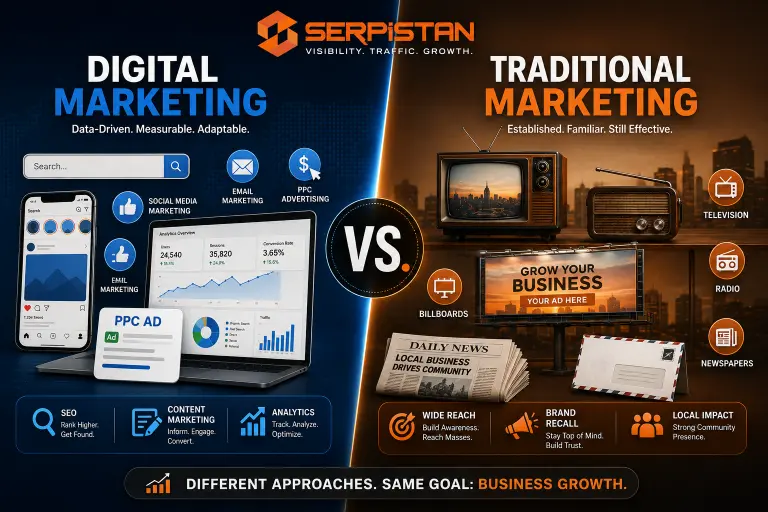
Traditional marketing generally reaches customers through offline channels such as television, radio, print, direct mail, billboards, and physical advertising. Digital marketing uses online channels such as search engines, websites, social media, email, content, and digital advertising.
The short answer: digital marketing often provides stronger measurability, targeting, flexibility, and optimization, but traditional marketing can still be valuable for certain audiences, industries, campaigns, and geographic markets. Neither approach is universally superior. The right answer depends on who your customers are, how they make decisions, and what you’re trying to achieve.
This article breaks down both approaches honestly, without pretending one is obsolete or the other is a silver bullet.
What Is Digital Marketing?
Digital marketing covers any marketing activity carried out through online channels. It’s not one thing, it’s a collection of connected disciplines that can work independently or reinforce each other.
The major channels include:
- SEO (search engine optimization): improving a website’s visibility in organic search results
- PPC (pay-per-click advertising): paid ads charged when someone clicks
- Social media marketing: building presence and engagement on platforms like Instagram, Facebook, LinkedIn, and TikTok
- Content marketing: blog posts, guides, and video that attract and educate an audience
- Email marketing: direct communication with people who’ve already opted in
- Local SEO: optimizing visibility for location-based searches, including Google Business Profile management
- Online reputation management: monitoring and responding to reviews and public perception
- Display advertising: visual ads placed across websites and apps
- Video marketing: content distributed through YouTube, social platforms, and websites
- Conversion rate optimization: improving how well a website turns visitors into customers
These channels aren’t meant to run in isolation. SEO brings in organic traffic, but strong content is what keeps that traffic engaged. PPC can fill gaps while SEO builds momentum over months. Email marketing turns one-time visitors into repeat customers. A business that treats these as one connected system usually outperforms a business running the same channels disconnected from each other.
What Is Traditional Marketing?
Traditional marketing is advertising and promotion delivered through offline, physical channels. It predates the internet by decades, and despite the rise of digital, it hasn’t disappeared.
Common traditional channels include:
- Television advertising
- Radio spots
- Newspaper and magazine ads
- Billboards and outdoor advertising
- Direct mail
- Flyers and brochures
- Print advertising in trade publications
- Event sponsorships and physical promotions
Traditional marketing still works well in specific situations: broad local awareness campaigns, audiences that skew older or less digitally active, industries where trust is built through physical presence (real estate signage, for example), and community-based businesses where being visibly present locally matters as much as the message itself. A well-placed billboard on a commute route, or a table at a local farmers market, can put a business in front of the exact people who live and shop nearby, without needing anyone to search for it first.
Digital Marketing vs. Traditional Marketing: What’s the Difference?
The clearest way to compare the two is side by side, factor by factor.
| Factor | Digital Marketing | Traditional Marketing |
|---|---|---|
| Audience targeting | Precise, based on demographics, interests, behavior, and intent | Broad, based on the medium’s general audience |
| Geographic targeting | Highly adjustable, down to a specific radius or zip code | Fixed by the medium’s coverage area |
| Cost flexibility | Budgets can scale up or down daily | Often requires larger upfront commitments |
| Tracking | Clicks, visits, and conversions measured directly | Harder to trace a specific action back to the ad |
| Attribution | Multi-touch tracking is possible, though imperfect | Generally limited to surveys or promo codes |
| Speed of launch | Campaigns can go live within hours | Production and placement often take weeks |
| Optimization | Adjustable mid-campaign based on performance data | Usually locked in once printed or aired |
| Customer interaction | Two-way: comments, messages, clicks | Mostly one-way |
| Content lifespan | Organic content can keep generating traffic for years | Ad exposure ends when the campaign ends |
| Personalization | Messaging can vary by audience segment | Same message for every viewer |
| Reach | Narrow or broad, by design | Often broad by default, shaped by the medium |
| Brand awareness | Builds through repeated digital touchpoints over time | Can build quickly through mass local or regional exposure |
| Lead generation | Direct paths from ad to form, call, or chat | Requires a secondary action (a phone call, a visit) |
Neither column wins across the board. Digital marketing wins clearly on targeting, tracking, and speed of adjustment. Traditional marketing still holds its own on broad local exposure and reaching audiences that digital campaigns sometimes miss.
Which Is More Cost-Effective?
There’s no universal answer here, and any article claiming there is one is oversimplifying. Cost-effectiveness depends on the campaign’s objective, the target audience, the industry, the geographic market, customer lifetime value, available budget, creative and media costs, conversion rate, and the length of the sales cycle.
Digital marketing often allows a business to start with a smaller budget and adjust based on what’s actually working. A $500 test budget on a search campaign can reveal a lot about what converts before a business commits $5,000. That flexibility is a real advantage.
That said, digital isn’t automatically cheap. Highly competitive keywords in PPC can cost more per click than a business expects, and organic SEO requires sustained investment in content and technical work before it pays off. Traditional media can also be efficient in the right context, a local radio spot in a small market may cost far less per impression than a national digital campaign competing in a crowded space.
Which One Is Easier to Measure?
Quick Answer
Digital marketing is generally easier to measure and optimize than traditional marketing because businesses can track online interactions such as clicks, website visits, leads, and conversions. However, attribution is not perfect, and traditional marketing can still be effective for awareness and local reach.
Digital metrics available to most businesses include website traffic and traffic sources, organic search visibility and rankings, click-through rate, conversion rate, cost per lead, cost per acquisition, engagement, revenue attribution where tracking is set up correctly, and return on ad spend (ROAS).
This is a genuine advantage. A business running a search ad can see, within days, whether that ad is generating clicks that turn into leads. That kind of feedback loop simply doesn’t exist with a print ad.
But it’s worth being honest about the limits. Multi-touch attribution, the process of figuring out which touchpoint in a customer’s journey actually drove the sale, is still an imprecise science, even with modern analytics tools. Someone might see a social ad, later search the brand name directly, and the analytics might credit the search rather than the ad that started the interest. Digital tracking is far better than nothing, but it isn’t perfect.
Traditional campaigns can be measured too, just less directly. Unique phone numbers, dedicated landing pages, coupon codes, and post-campaign surveys are all standard ways to estimate traditional marketing’s impact. It requires more deliberate setup, and the data is generally less granular, but it’s not a black box.
Which One Is Better for Small Businesses?
Digital marketing tends to be particularly useful for small businesses, for a few concrete reasons:
- Budgets can start small and scale as results come in
- Local targeting lets a business reach only the customers within their actual service area
- Search visibility means a business can be found by people already looking for what they offer
- Content built once can keep attracting traffic long after it’s published
- Niche targeting lets a small business compete without a mass-market budget
- Campaign performance is visible early, so budget isn’t locked into something that isn’t working
This doesn’t mean traditional marketing has no place for small businesses. A local bakery sponsoring a school event, or a contractor’s truck wrap driving around a service area, can generate real word-of-mouth and local recognition that digital campaigns don’t replicate as naturally. The deciding factor is usually where the business’s actual customers are looking when they’re ready to buy.
Which One Is Better for Local Businesses?
Local businesses generally benefit from combining several tactics rather than picking one channel exclusively.
Digital
- Local SEO
- Google Business Profile optimization
- Local search visibility
- Online reviews
- Paid search targeted to a specific radius
- Social media for community engagement
Traditional
- Community events
- Direct mail to a specific neighborhood
- Local sponsorships
- Referral marketing
- Local print or radio, depending on the market
The real question isn’t “digital or traditional” for a local business, it’s: how do this specific business’s customers actually discover and evaluate local options? A dentist’s office and a landscaping company might have very different answers, even though both are local, because their customers search, compare, and decide differently.
Which One Builds Brand Awareness Better?
Both can build awareness, just through different mechanisms.
Traditional channels like TV, radio, outdoor advertising, and direct mail can create broad exposure within a local or regional area relatively quickly. A billboard on a major highway or a radio spot during a popular time slot puts a brand in front of a large number of people, regardless of whether those people are actively looking for that product or service at that moment.
Digital awareness works differently, and reviews are a good example of why. BrightLocal’s 2026 Local Consumer Review Survey, a representative study of 1,002 US consumers, found that the vast majority of shoppers read reviews before choosing a local business, and most who read a positive review go on to do further research, commonly by visiting the business’s website, rather than converting immediately (BrightLocal, 2026 ↗). That pattern is a useful illustration of why digital awareness and digital conversion are connected steps rather than separate outcomes: a review builds trust, but the website or next touchpoint is often what turns that trust into an actual decision.
Digital channels build awareness through search, social media, video, content, influencer or creator partnerships, online communities, and display advertising.
Which One Is Better for Lead Generation?
Digital marketing generally has an edge in structured lead generation, because it can connect intent directly to action.
Digital lead paths
- Search intent → landing page → form
- One-offer landing pages with a clear CTA
- Retargeting for non-converting visitors
- Email nurture sequences
- Paid search and social lead forms
Traditional lead paths
- Phone calls generated by an ad or listing
- Direct mail responses
- Promotional offers redeemed in person
- QR codes bridging a physical ad to digital
- Leads collected at events
The volume of leads matters less than most businesses assume. A campaign generating 200 leads a month that rarely convert to paying customers is worth less than a campaign generating 20 leads a month that consistently close. Businesses evaluating marketing performance should look at qualified leads and resulting revenue, not raw lead count.
Is Traditional Marketing Still Effective in 2026?
Quick Answer
Yes. Traditional marketing is not obsolete. It tends to work particularly well for mass local awareness, less digitally active audiences, geographic campaigns, community-based businesses, events, broad brand-building, and industries where physical presence matters.
The real question isn’t whether traditional marketing is “dead.” It’s whether a specific traditional channel is appropriate for a specific audience and objective. A direct mail campaign for a retirement community service might perform very differently than the same channel used for a software startup targeting 25-year-olds.
Is Digital Marketing Better in 2026?
Digital marketing has become increasingly central to how customers research and choose businesses, largely because a growing share of the buying process now happens online before any direct contact with a business occurs.
This shows up in a few consistent behaviors: customers commonly search for a business before reaching out, mobile research happens throughout the day, reviews and social proof influence decisions before someone picks up the phone, online comparison is often part of the process even for local purchases, and AI-assisted search and discovery tools are increasingly part of how people find and evaluate answers, alongside traditional search engines.
None of this means every customer, in every industry, researches exclusively online. It does mean that a business with weak or absent digital visibility is often invisible during a stage of the buying process that used to happen entirely offline. Digital marketing’s importance in 2026 isn’t about replacing every traditional tactic, it’s about making sure a business shows up at the point where research now commonly happens, including in AI-driven search results, which are becoming a larger part of that research stage alongside traditional search engines.
SEO vs. Traditional Advertising
SEO and traditional advertising solve different problems, and comparing them directly only makes sense once that’s clear.
SEO works by capturing demand that already exists. Someone is searching for something, and SEO’s job is to make sure a relevant, well-optimized page is there to answer that search. It relies on understanding search intent, building organic visibility over time, producing content that actually answers what people are looking for, local SEO for location-based searches, and a long-term, compounding effect, where visibility built months ago continues generating traffic.
Traditional advertising, by contrast, generally works by creating exposure, whether or not the viewer was actively looking for the product or service at that moment. A business pays for placement within a medium for a defined period.
SEO typically takes longer to show meaningful results than a traditional ad campaign, since it depends on search engines building trust in a site over time. It’s not something that guarantees a specific ranking or a specific amount of traffic; any claim promising guaranteed rankings should be treated with skepticism. But once SEO gains traction, it tends to keep working with less ongoing spend than a traditional campaign that stops the moment the budget runs out.
Paid Digital Advertising vs. Traditional Advertising
Paid digital channels, PPC, social advertising, and display advertising, share some structural advantages over traditional paid media: precise targeting by behavior, interest, and demographics; daily budget control; the ability to test multiple creative variations at once; near real-time measurement; fast launch; and geographic targeting down to a specific area.
TV, radio, print, billboards, and direct mail offer less granular targeting and slower feedback, but they can still deliver strong reach within a defined local or regional market, and some audiences respond to them in ways digital ads don’t replicate.
It’s worth being clear that paid digital advertising isn’t automatically effective just because it’s digital. A poorly targeted campaign, weak creative, or a landing page that doesn’t convert can waste a digital ad budget just as easily as a poorly placed billboard wastes a traditional one. The channel matters less than the quality of the strategy behind it.
The Best Strategy May Be a Combination of Both
Framing this as strictly “digital or traditional” misses how most successful businesses actually operate. The customer journey often crosses both worlds, and the right mix depends on the specific business.
Local Service Business
Digital: local SEO, search ads, review management, a clear service website
Traditional: local sponsorships, direct mail to nearby neighborhoods, community events
Retail Business
Digital: social media, email marketing, search visibility, online advertising
Traditional: in-store signage, local events, print promotions tied to sales
B2B Company
Digital: SEO, LinkedIn presence, content marketing, email nurture sequences, PPC
Traditional: trade shows, in-person networking, industry events
In each case, digital and traditional aren’t competing for the same budget line, they’re solving different parts of the same problem. The mix that works depends on customer behavior and the economics of the specific business, not a generic rule about which channel is “better.”
How to Decide Where Your Marketing Budget Should Go
Rather than starting from a channel and working backward, start from these questions:
- Who is the target customer?
- Where do they actually discover businesses like this one?
- What problem are they trying to solve when they start looking?
- How long is the typical buying cycle?
- What is the average customer value?
- How quickly do you need results?
- Can the campaign realistically be measured?
- What channels are competitors already using successfully?
- What is the actual available budget?
- Which channels can be executed consistently, not just launched once?
That last question matters more than it seems. A brilliant campaign that runs once and then stops rarely outperforms a modest campaign that runs consistently for months. Businesses are generally better served testing a channel with a defined budget, measuring the result, and reallocating based on actual performance, rather than committing an entire year’s budget based on assumptions about what “should” work.
How Serpistan Approaches Digital Marketing
Effective digital marketing isn’t a matter of posting occasionally on social media or running a single ad campaign and hoping for the best. It works best as an interconnected strategy, where search visibility, content, paid advertising, and website performance all support each other rather than operating as separate, disconnected efforts.
At Serpistan, that means treating channels like SEO, local SEO, PPC, and content marketing as parts of one system rather than isolated line items. Content and technical fundamentals matter here too: our guides on the on-page SEO checklist and technical SEO basics go deeper into what “built for search visibility” actually means in practice. A web design project that isn’t built with conversion and search visibility in mind, for example, undercuts the value of the SEO and advertising work happening around it. The same is true in reverse: strong ad targeting sends more traffic to a site, but that traffic only turns into business if the site and follow-up process are built to convert it.
The businesses that get the most out of digital marketing are usually the ones that treat it as an ongoing, measurable process rather than a one-time project, testing what works, adjusting what doesn’t, and building on the channels that actually produce results for their specific market.
Digital Marketing vs. Traditional Marketing: Which One Should You Choose?
Choose digital marketing when
- Your customers actively search online before buying
- You need campaigns that can be measured and adjusted
- You want budget flexibility rather than a large upfront commitment
- You want to target specific audiences precisely
- You need leads that can be tracked back to a specific source
Consider traditional marketing when
- Your specific audience responds strongly to offline channels
- You need broad awareness across a defined local or regional area
- Physical presence and visibility matter to how your business is perceived
- Community involvement is a meaningful part of your reputation
Consider combining both when
- Your customers move between online and offline touchpoints before deciding
- You need both broad awareness and trackable, measurable acquisition
- Your market includes multiple customer segments with different habits
For most businesses in 2026, this isn’t a binary decision. It’s a question of proportion, how much budget and effort goes toward each approach, based on where the actual customers are and how they actually decide.
Not Sure Where Your Marketing Budget Should Go?
Serpistan helps businesses build a measurable digital strategy, without abandoning what’s already working offline.
Frequently Asked Questions
What is the difference between digital marketing and traditional marketing?
Digital marketing uses online channels like search engines, social media, email, and websites to reach customers. Traditional marketing uses offline channels like TV, radio, print, billboards, and direct mail. The core difference is where and how the audience is reached, and how precisely that reach can be measured.
Is digital marketing cheaper than traditional marketing?
Not always, but it often allows more budget flexibility. Digital campaigns can start small and scale based on performance, while traditional media often requires a larger upfront commitment. Cost-effectiveness ultimately depends on the audience, industry, and campaign goals, not the channel type alone.
Is traditional marketing still effective in 2026?
Yes. Traditional marketing remains effective for broad local awareness, certain audiences, community-based businesses, and industries where physical presence matters. It’s not obsolete, it’s just better suited to specific goals than others.
Which is better for small businesses: digital or traditional marketing?
Digital marketing tends to be more accessible for small businesses because of its budget flexibility, local targeting options, and measurable results. That said, local offline marketing, like sponsorships or direct mail, can still play a meaningful role depending on the business and community.
Which type of marketing is easier to measure?
Digital marketing is generally easier to measure, since clicks, visits, leads, and conversions can be tracked directly. Traditional marketing can be measured too, using tools like unique phone numbers or promo codes, but the data is typically less precise.
Is SEO considered digital marketing?
Yes. SEO is one of the core disciplines within digital marketing, focused on improving a website’s visibility in organic search results.
Can digital and traditional marketing work together?
Yes, and for many businesses, combining both produces stronger results than relying on either exclusively. A customer’s journey often crosses both online and offline touchpoints before a decision is made.
Which marketing method generates leads faster?
Digital marketing, particularly paid advertising, can generate leads faster because campaigns can launch quickly and connect directly to a form, call, or chat. Traditional marketing can also generate leads, but the response path is often less direct.
How should a business choose its marketing channels?
Start with the customer: where they look for solutions, how long their buying process takes, and what they value. From there, test channels with a defined budget, measure actual performance, and reallocate based on results rather than assumptions.
How much should a business spend on digital marketing?
This varies significantly by industry, competition, and business goals, and any specific number offered without knowing those details would be a guess rather than useful advice. A practical approach is starting with a test budget on one or two channels, measuring performance, and adjusting from there.