
Updated May 2026
16 min read
One of the first questions businesses ask when they invest in SEO is also one of the hardest to answer with a single number: how long does SEO actually take to work? The honest answer is that it doesn’t run on a fixed schedule, and anyone promising you a specific ranking in 30 days isn’t being straight with you.
Scaling SEO-driven revenue for 400+ businesses across the USA, UK, Canada, and Dubai · On-page and off-page SEO expert at Serpistan
How Long Does SEO Take?
SEO commonly takes several months to produce meaningful results, but there is no universal timeline. The timeframe depends on website age and history, existing organic visibility, technical SEO, content quality, search intent, keyword competition, industry, geographic market, website authority, internal linking, relevant links and mentions, available resources, and how quickly recommendations actually get implemented.
A newer website competing for highly competitive searches will typically take longer than an established website targeting less competitive, highly relevant queries. What matters most is understanding that SEO results rarely happen all at once. You’ll usually see technical improvements first, then increased crawling and indexing, then keyword movement, then more impressions, then more organic clicks, more qualified traffic, and eventually leads and conversions. These stages can overlap, and not every website follows the same sequence.
Why SEO Doesn’t Work Instantly
Paid advertising can generate traffic as soon as a campaign goes live. SEO works differently, since search engines need to discover pages, crawl them, process and understand them, determine relevance, evaluate the site’s broader signals, and reassess the page as the site changes. That sequence is why SEO should be treated as a longer-term channel rather than an instant traffic switch, not a flaw in how it’s being run.
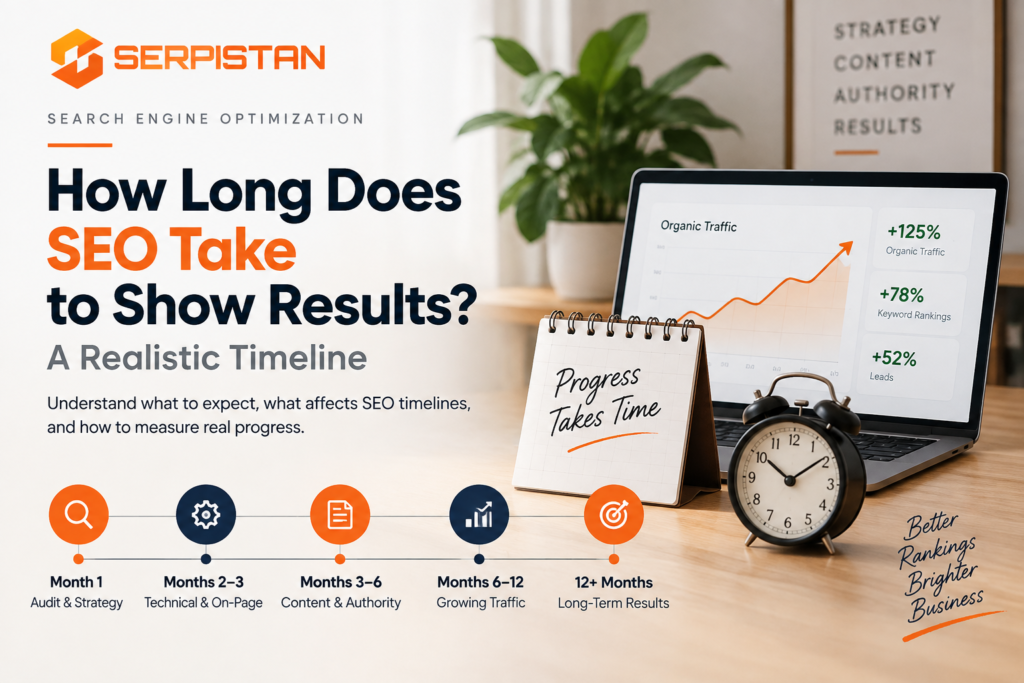
A Realistic SEO Timeline
Every campaign is different, but this framework is a useful way to think about progress. These are planning ranges, not guarantees. Some sites see meaningful movement sooner, others need more time, and the timeline should always be read alongside the site’s starting point and competitive environment.
| Timeframe | Typical Focus | What You May See |
|---|---|---|
| Month 1 | Research, technical audit, strategy | Baseline established, technical issues identified |
| Months 1 to 2 | Technical fixes, architecture, optimization | Improved crawlability, indexing changes |
| Months 2 to 3 | Content and on-page improvements | Early keyword movement and impressions |
| Months 3 to 6 | Content expansion and authority building | More rankings, clicks, qualified traffic |
| Months 6 to 12 | Scale and refinement | Stronger organic visibility and conversions |
| 12+ months | Compounding growth | Broader keyword coverage and greater authority |
Building the Foundation
The first month is about understanding the website and fixing foundational problems, not publishing dozens of articles with no strategy behind them. Common first-month work includes a technical SEO audit, keyword research, search intent analysis, competitor research, an indexing and internal linking review, an existing content audit, and setting up analytics and Search Console properly.
Correcting broken links, incorrect indexing directives, duplicate pages, or major technical errors can improve how a site gets crawled relatively quickly. That doesn’t mean a dramatic revenue increase should be expected after 30 days. The goal here is a strong foundation and a measurable baseline.
Early Signals Start Showing
By month two, implementation should start generating useful data: search impressions, indexed pages, keyword rankings, organic clicks, and which pages are receiving traffic. The goal isn’t celebrating every ranking increase, it’s asking whether the site is moving toward the right searches. Ranking for an irrelevant keyword doesn’t create business value. An increase in impressions for keywords closely tied to the business is a more meaningful early signal.
A Useful Checkpoint
By 90 days, there’s usually enough data to see which pages are gaining visibility, which keywords are moving, and where technical problems remain. Some businesses see meaningful traffic increases here. Others, particularly new websites or those in highly competitive industries, are still in an earlier stage. A three-month review should focus on trajectory, not an arbitrary traffic target.
Consistent Work Becomes Easier to Evaluate
Around six months, a site typically has more indexed content, better rankings, greater keyword coverage, and more organic conversions. Six months isn’t a guaranteed finish line though. A national ecommerce site with thousands of competitors operates in a completely different environment than a local service business targeting a small geographic market, and needs longer accordingly.
Compounding Value
A year gives a much larger window for evaluating an SEO strategy. A successful campaign has usually expanded visibility across core commercial keywords, long-tail searches, informational topics, service pages, and supporting content. The real advantage here is compounding value: a useful article keeps attracting traffic, a strong service page keeps generating leads, and internal links connect newer and older content. SEO isn’t about what happens in a given month, it’s about building an asset that keeps producing value.
What Determines the Timeline
There’s no single “SEO clock.” Several variables speed up or slow down the process.
Website age and history. A brand-new domain starts differently than an established one, but age alone doesn’t guarantee rankings. An older site can have serious technical or content problems, while a newer site can perform well when it genuinely satisfies search intent.
Existing website authority. What matters isn’t a number, it’s whether the site has earned real recognition within its topic or industry through relevant links and existing content.
Keyword competition. “Emergency plumber in a small city” and “insurance” operate in completely different competitive environments. Keyword research needs to weigh search intent, competition, business relevance, demand, and conversion potential together, not just search volume.
Search intent. A page can be technically excellent and still struggle if it doesn’t match what searchers actually want. Someone searching “how to improve website speed” is usually looking for educational content, not a sales pitch for web development services. See our SEO strategy approach for how we scope content to intent.
Website quality. Navigation, mobile usability, content quality, page structure, and conversion paths all matter. Google’s own guidance emphasizes creating helpful, reliable, people-first content rather than content built primarily to manipulate rankings.
Technical SEO. Incorrect robots directives, duplicate URLs, canonicalization problems, slow pages, and broken redirects can all interfere with crawling and indexing. Fixing these issues improves the foundation everything else depends on. Our breakdown of technical SEO and the other core SEO disciplines covers this in more depth.
Content quality and coverage. This isn’t about publishing as many articles as possible. It’s about improving existing pages, filling real topic gaps, and strengthening topical coverage with original information and genuine expertise.
Relevant links and mentions. Acquiring hundreds of low-quality links isn’t a sustainable shortcut. The better question is whether reputable, relevant sites are actually recognizing the business, through industry publications, partners, or original research.
Geographic competition. Local SEO campaigns run on different timelines than national ones. Google confirms local results are primarily influenced by relevance, distance, and prominence, according to its own guidance on improving local ranking. Our local SEO services are built around exactly this dynamic.
How quickly recommendations get implemented. This one is often overlooked. If an audit identifies 20 technical problems and 10 pages needing optimization, and none of it gets implemented, the campaign can’t move forward, no matter how good the strategy is.
How to Tell Whether SEO Is Working
One of the biggest mistakes is waiting for revenue before measuring anything. SEO has both leading and lagging indicators, and both matter.
Rankings Are Not the Only KPI
A campaign ranking #2 for a keyword with little business relevance is often worth less than a campaign ranking #7 for a high-intent keyword that generates qualified leads. SEO reporting should connect search performance to actual business outcomes, not just position numbers.
Organic Traffic Can Be a Misleading KPI
A business selling commercial HVAC services might get thousands of visits from an article about how HVAC systems work. That’s useful for awareness, but far less valuable than a smaller amount of traffic from “commercial HVAC installation [city],” where the search intent is much closer to a purchase decision. Good SEO focuses on relevant traffic, not traffic at any cost.
A 12-Month SEO Roadmap
- Months 1 to 3, Foundation. Audit, research, technical fixes, architecture, priority page optimization, analytics and Search Console setup, and initial content. Goal: a strong foundation and measurable progress.
- Months 4 to 6, Expansion. Content development, internal linking, commercial pages, supporting content, local optimization where relevant, and authority building. Goal: expand visibility around important topics and services.
- Months 7 to 9, Optimization. Analyze top and underperforming pages, keyword opportunities, conversion performance, and content gaps, then improve what’s already working. Goal: turn early gains into stronger performance.
- Months 10 to 12, Scale. Expand successful strategies into new topics, services, locations, and content formats. Goal: build a sustainable organic growth engine.
SEO vs. Paid Search
| SEO | Paid Search | |
|---|---|---|
| Traffic potential | Usually develops over time | Can begin quickly |
| Cost model | Investment in site, content, authority | Typically pay per click or action |
| Results | Can compound | Usually tied to ongoing spend |
| Best use | Long-term organic visibility | Immediate demand capture |
The two don’t need to compete. Many businesses use both, paid search captures demand while SEO builds organic visibility that keeps paying off after the ad spend stops.
Want a Realistic Timeline for Your Site?
We’ll audit your current SEO position and give you a straight answer, not a guaranteed date.
Frequently Asked Questions
How long does SEO take to work?
SEO often takes several months to produce meaningful results, but there’s no universal timeline. It depends on competition, website history, technical condition, content quality, authority, search intent, geographic market, and how quickly recommendations get implemented.
Can SEO results happen in one month?
Yes, some changes can produce relatively quick improvements, particularly when serious technical or indexing issues get corrected. That said, businesses shouldn’t expect substantial traffic or revenue growth within one month.
Is six months enough for SEO?
Six months can provide enough time to evaluate meaningful progress for many campaigns, but it isn’t a guaranteed endpoint. Highly competitive markets and new websites may need longer.
How long does it take to rank on Google?
There’s no fixed ranking timeline. Some pages can begin ranking relatively quickly, while competitive keywords can take considerably longer. Google doesn’t guarantee a particular ranking position or timeframe, as covered in its own SEO Starter Guide.
Why is my SEO not working after three months?
Possible causes include highly competitive keywords, poor search-intent alignment, unresolved technical issues, insufficient content quality, limited authority, slow implementation, or targeting keywords with little real business value. Review the underlying data rather than assuming three months automatically means failure.
How long does local SEO take?
Local SEO timelines vary by market, competition, website condition, reviews, Business Profile quality, and overall local prominence. Local businesses often see different patterns than national websites, since local results also factor in geographic distance and relevance.
Is SEO worth it for a small business?
SEO can be valuable when there’s meaningful search demand and the business can convert organic visibility into customers. The right investment depends on the market, competition, customer acquisition economics, and business goals, not a generic yes or no.
The Real Question to Ask
There is no single number for how long SEO takes. For most businesses, it should be measured in months rather than days, with progress developing through a sequence of technical improvements, better content, stronger relevance, increased visibility, and eventually more qualified traffic and conversions.
The question that actually matters isn’t “did we reach page one in 90 days.” It’s whether the right signals are moving in the right direction, and whether that progress is creating real business value. Look at impressions, relevant rankings, organic clicks, qualified traffic, leads, and revenue, not just where a keyword sits today.