
Updated May 2026
17 min read
If you run a small business, being visible to customers in your service area can matter more than ranking for broad searches across the entire internet. Someone searching “plumber in Dallas” or “dentist near me” isn’t browsing, they’re often looking for a business they can call, visit, or hire today. That’s what local SEO is built for.
Scaling SEO-driven revenue for 400+ businesses across the USA, UK, Canada, and Dubai · On-page and off-page SEO expert at Serpista
What Is Local SEO?
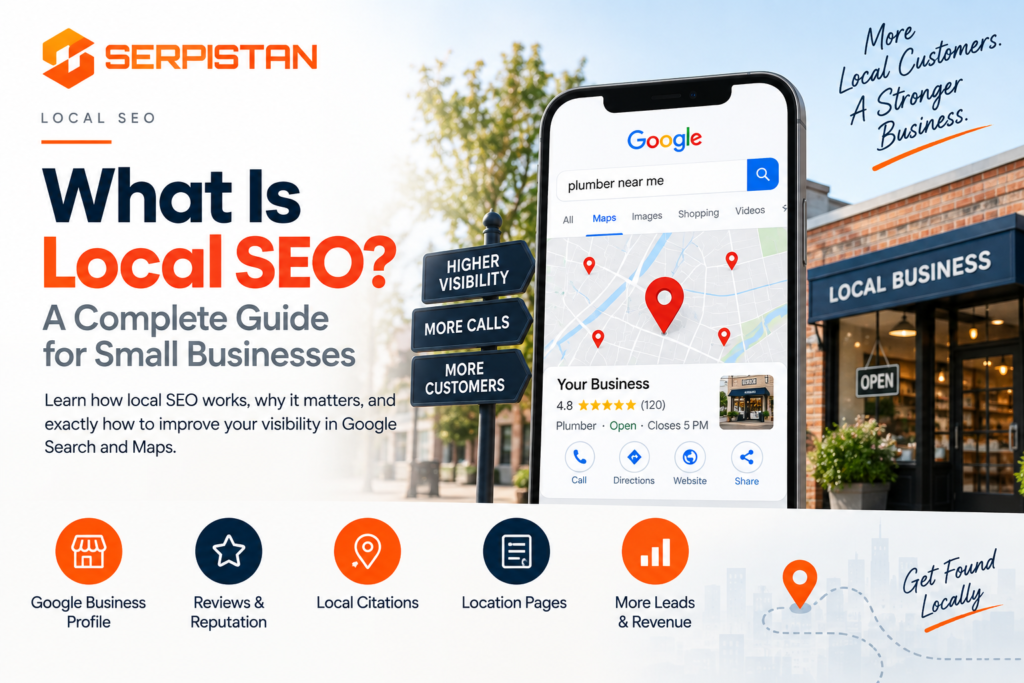
Local SEO is the process of improving a business’s visibility in search results when geographic relevance matters to the search. It combines your website, Google Business Profile, reviews, business information, local content, links, citations, and other signals that help search engines understand what your business does and where it operates.
Google says local results are primarily based on relevance, distance, and prominence, and that complete, accurate business information helps Google match a business with relevant searches, according to Google’s own guidance on improving local ranking. For small businesses, that means local SEO offers a way to compete for customers in a defined market without trying to rank nationally for every broad keyword.
Local SEO has two connected objectives: helping search engines understand the business and its geographic relevance, and helping potential customers find and evaluate the business once they see it. Both matter equally. A perfectly optimized profile that never converts a visitor into a customer isn’t doing its job.
Local SEO vs. Traditional SEO
Both use the same fundamentals: keyword research, content, technical SEO, internal linking, and search intent. The difference is geographic intent. Traditional SEO might target “email marketing software,” a search that doesn’t depend on where the searcher is. Local SEO might target “email marketing agency Boston,” where location changes everything about who should rank.
The Three Main Local Ranking Factors
According to Google’s own local ranking guidance, local results are mainly based on three things.
Relevance
How well a Business Profile matches what someone is searching for. If someone searches “Italian restaurant,” Google needs to determine which businesses actually match. Complete, detailed business information helps Google understand what your business does.
Distance
How far a business is from the searcher or the location specified in the search. For a search like “coffee shop near me,” distance can be decisive. A business across town won’t outrank a highly relevant competitor around the corner just because it has more optimized content.
Prominence
How well-known a business is. Google says prominence can be influenced by links and reviews, more reviews and positive ratings can help local ranking. This is where broader SEO, reputation management, and local authority intersect with local search specifically.
Google Business Profile
Google Business Profile is one of the most visible components of local SEO, letting eligible businesses manage the information that shows up across Google Search and Maps: name, category, address or service area, phone number, hours, services, and photos. Google recommends keeping this information complete and accurate, verifying the business, responding to reviews, and adding photos and video, per its official local ranking guidance.
Google also explains that profile information doesn’t come only from the business owner. It’s compiled from publicly available web content, third-party data, user contributions, and Google’s own interactions with a business, according to Google’s guidance on how it sources and uses Business Profile information. That’s exactly why your own website’s accuracy still matters, even after your profile is fully claimed.
Google Business Profile Checklist
- ✓ Claim and verify the profile
- ✓ Use your correct real-world business name, no keyword stuffing
- ✓ Select the most appropriate primary category, plus relevant secondary categories
- ✓ Provide accurate address or service-area information
- ✓ Add the correct phone number, website, and hours
- ✓ Add relevant services and high-quality photos
- ✓ Monitor and respond to reviews, and keep information updated
The goal isn’t to stuff keywords into every available field. It’s to accurately represent the business, Google specifically advises against unnecessary information or keyword stuffing in the profile name.
Local SEO and Your Website
Your Google Business Profile is important, but your website remains a central part of local search strategy. It should make it clear what the business does, who it serves, where it operates, and how customers can get in touch, in a way that’s easy for both users and search engines to understand.
Local Keyword Research
Start with what customers actually search for, not just a city name bolted onto every page. That includes service-plus-location searches (“SEO agency Austin”), service-area searches where Google infers location (“dentist near me,” “emergency plumber”), and informational local searches (“how much does a roof replacement cost in Dallas”). Not every local search is transactional, and informational queries create real content opportunities.
Location Pages: When Are They Useful?
Location pages can be valuable for businesses that genuinely serve multiple geographic markets. But simply swapping one city name for another across dozens of nearly identical pages isn’t a strategy, it’s thin content. A useful location page includes real service-area information, local customer examples, relevant testimonials, location-specific FAQs, and genuine geographic context. The test worth applying: would this page be useful even if Google didn’t exist? If not, it probably shouldn’t exist either.
Local SEO and Technical SEO
Local SEO doesn’t replace technical SEO. Your site still needs to be crawlable, indexable, mobile-friendly, fast, and well structured, this matters even more for larger local businesses with multiple locations or large service-page libraries. You can also add LocalBusiness structured data to communicate business details like hours and address, but it should accurately reflect what’s already visible on the page, not manufacture local relevance that doesn’t exist.
Reviews, Citations, and Links
Reviews
Reviews contribute to prominence, and just as importantly, they help customers decide whether to contact the business at all. A legitimate review process is simple: deliver a good customer experience, ask honestly for feedback, make leaving a review easy, respond professionally, and use recurring complaints to improve the actual experience. Avoid fake reviews, purchased reviews, or employees posing as customers, these create policy problems and undermine the trust reviews are supposed to build.
Local Citations and NAP Consistency
A local citation is an online mention of your business’s name, address, and phone number (NAP), often appearing across business directories, industry sites, and local publications. Since Google compiles profile information from multiple sources across the web, keeping this information accurate everywhere it appears genuinely matters. Our own complete guide to business listings and citations covers how to audit and prioritize this work. Don’t obsess over minor formatting differences like “St.” versus “Street,” the underlying accuracy is what matters.
Local Links and Mentions
Links from relevant local sources, news outlets, industry associations, chambers of commerce, and community organizations, contribute to prominence. The goal isn’t links from every local website that will have you, it’s relevance and genuine relationships over volume.
Local SEO by Business Type
Not every business needs the same local SEO approach, and not every business needs local SEO at all.
| Business Model | Primary Strategy |
|---|---|
| One local location | Local SEO |
| Local service-area business | Local SEO |
| Several nearby cities | Local or regional SEO |
| Multi-location company | Local + national SEO |
| National ecommerce | National SEO |
| Nationwide SaaS | National SEO |
The key question: does geography influence whether someone can actually use your business? If yes, local SEO is likely important, regardless of business size.
Service-area businesses without a storefront, plumbers, electricians, mobile mechanics, need to represent their actual service area accurately rather than claiming physical offices in cities they don’t operate from. Multi-location businesses need the relationship between locations made clear on the site, with each location typically needing its own profile, address, hours, and reviews, not duplicated or artificial listings created just to target extra markets.
Building Your Local SEO Strategy
- Step 1: Establish your business information. Make sure name, address, phone, hours, and services are all accurate.
- Step 2: Claim and optimize your Google Business Profile. Complete it fully and keep it updated.
- Step 3: Optimize your website. Clear pages for core services, main locations, and the questions customers actually ask.
- Step 4: Build a review process. Ask genuine customers for honest feedback and respond professionally.
- Step 5: Audit your citations. Find important listings and correct inaccurate information.
- Step 6: Create useful local content. Answer the questions your local customers actually ask.
- Step 7: Build local authority. Pursue relevant partnerships, organizations, and community opportunities.
- Step 8: Measure results. Track visibility, engagement, leads, and business outcomes, then adjust.
Common Local SEO Mistakes
- ✕ Keyword stuffing. Repeating a city name doesn’t automatically make a page locally relevant.
- ✕ Creating fake locations. Don’t build profiles or pages for places you don’t genuinely operate in.
- ✕ Ignoring the website. Your Business Profile is important, but Google still draws heavily on your own site’s content.
- ✕ Buying reviews. Fake reviews undermine trust and create real policy risk.
- ✕ Mass-producing thin location pages. A city-name swap is not a content strategy.
- ✕ Focusing only on rankings. Track the full path: visibility to visits to calls to leads to customers.
Want Your Local Presence Actually Working for You?
We’ll audit your Business Profile, citations, and website together, not just one piece of the puzzle.
Frequently Asked Questions
What is local SEO?
Local SEO is the process of improving a business’s online visibility for geographically relevant searches. It involves optimizing the business website, Google Business Profile, reviews, local content, and citations to help customers find the business in a specific geographic market.
How does local SEO work?
Local SEO works by helping search engines understand what a business does, where it operates, and how relevant and prominent it is for local searches. Google says local results are primarily based on relevance, distance, and prominence.
Is Google Business Profile important for local SEO?
Yes. It’s a core part of local SEO for eligible businesses, letting you provide category, location, hours, website, services, and photos. Google recommends keeping this information complete and accurate at all times.
How can a small business improve local SEO?
By optimizing Google Business Profile, creating useful service and location pages, maintaining accurate business information everywhere it appears, earning genuine reviews, managing citations, improving technical SEO, and building relevant local authority.
How long does local SEO take?
There’s no universal timeline. It depends on competition, geographic market, website quality, existing authority, reviews, and technical condition. Focus on improving the underlying signals rather than expecting a guaranteed ranking by a set date.
The Real Takeaway
You don’t need to be the biggest business on the internet to become more visible to customers in your market. You need to clearly communicate what you do, where you operate, who you serve, and why customers should choose you, and represent that information accurately across your website, your Google Business Profile, and the broader web.
Local SEO isn’t a single tactic or a one-time directory submission project. It’s the process of building a consistent, trustworthy local presence that helps both search engines and real customers understand your business. Reviewing what’s worked for businesses like yours in our case studies is often a faster starting point than building a strategy from scratch.