
COMPARISON
10 MIN READ
A common misconception treats Facebook Ads and Instagram Ads as two completely separate advertising systems that a business has to pick between. In practice, both are part of Meta’s advertising ecosystem, and the same Marketing API that advertisers use to build campaigns is described as “a collection of Graph API endpoints and other features that can be used to help you advertise across Meta technologies,” spanning “Facebook, Instagram, Messenger, and WhatsApp” (Meta for Developers: Marketing API ↗). A single campaign can often reach audiences across more than one of these placements, while performance still varies by audience, creative, objective, and placement.
That means the real question in this comparison, facebook ads vs instagram ads, isn’t which platform is objectively better. It’s where your specific budget produces the best results for your specific business. Don’t decide your budget split based only on which platform seems more popular or which one you personally scroll through more. Use campaign data and business objectives to determine where budget is actually producing meaningful results.
This guide breaks down the practical differences between Facebook and Instagram advertising, when each tends to be worth testing, and a framework for deciding how to split a Meta Ads budget based on evidence rather than assumptions.
Facebook Ads vs. Instagram Ads: What’s the Difference?
| Factor | ||
|---|---|---|
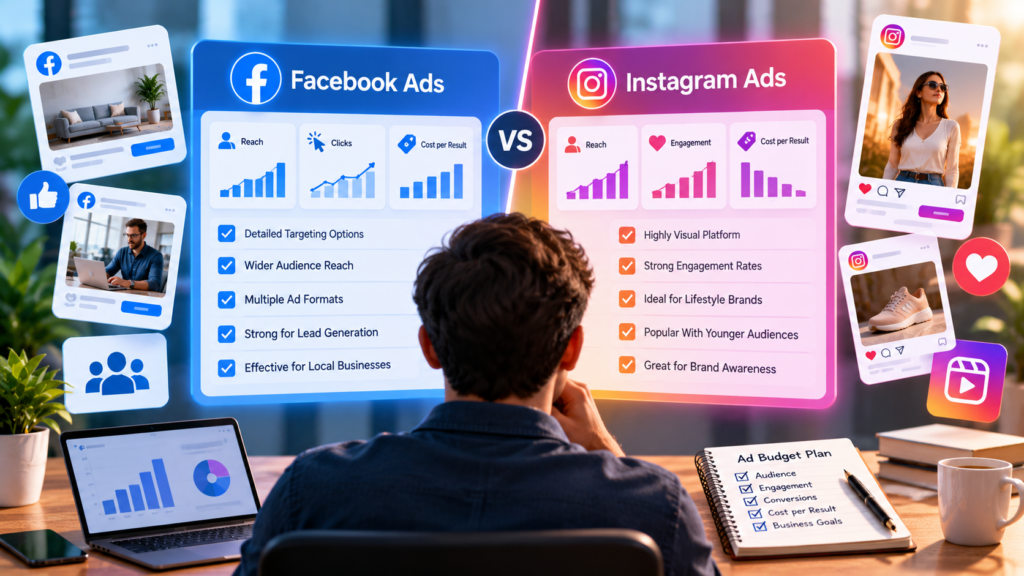
| Core experience | Social network with feeds, groups, pages, video, and other formats | Visual-first platform focused on photos, video, Stories, and Reels |
| Creative strengths | Variety of formats, information-rich environments | Visual storytelling, short-form content |
| Common business uses | Lead generation, local businesses, community campaigns | E-commerce, visual products, creator content, discovery |
| Audience considerations | Depends on market and campaign targeting | Depends on market and campaign targeting |
| Best approach | Test based on campaign data | Test based on campaign data |
These are tendencies, not rules. A local service business can perform well on Instagram, and an e-commerce brand can perform well on Facebook. The table is a starting point for thinking about creative and audience fit, not a verdict on where your specific business should spend.
Are Facebook Ads and Instagram Ads Actually Separate?
Not entirely. Both platforms sit inside Meta’s advertising ecosystem, and advertisers typically manage both through the same advertising tools rather than maintaining two unrelated systems. A few things worth understanding about that relationship:
- A single campaign can use multiple placements, including both Facebook and Instagram, depending on setup.
- Meta’s campaign structure organizes work into campaign, ad set, and ad levels, with placement controlled through targeting parameters at the ad set level (Meta for Developers: Ad Campaign Structure ↗).
- Which placements are actually available to a given campaign depends on the objective, creative format, and Meta’s current capabilities, which can change over time.
- A business doesn’t necessarily need completely separate campaigns just because it wants to reach both Facebook and Instagram users.
Because interface terminology and available options shift periodically, it’s worth checking Meta’s current documentation and Ads Manager interface at the time you build a campaign rather than assuming a past setup still works the same way.
Facebook Ads vs. Instagram Ads: Key Differences
Audience
Audience composition varies by market, industry, product, age group, and behavior, and it changes over time. Avoid relying on stereotypes like “Facebook is only for older people” or “Instagram is only for younger people.” These generalizations were never fully accurate and become less reliable every year as usage patterns shift. The more useful approach is examining your own campaign and customer data: where are your actual leads and customers coming from, and how does that compare across placements.
Creative Format
Facebook tends to support a wider range of creative formats, which can work well for feed ads, longer-form messaging where appropriate, video, image ads, lead-focused creative, and community-oriented messaging.
Instagram leans toward visual-first formats: Reels, Stories, high-quality product imagery, creator-style content, short-form video, visual demonstrations, and lifestyle content.
These are tendencies rather than universal rules. A well-produced video can work on both platforms, and a strong image ad isn’t exclusive to Facebook.
User Intent and Customer Journey
People can encounter advertising at different stages of the buying journey on both platforms, including awareness, discovery, consideration, retargeting, conversion, and repeat purchase. Platform choice should reflect where your actual customers tend to be in that journey rather than an assumption about which platform “belongs” to which stage. A business whose customers browse casually before buying might lean on Instagram for discovery and Facebook for retargeting, while another might see the opposite pattern in its own data.
Ad Formats and Placements
Advertisers may have access to multiple placements across Meta’s ecosystem, including feed, Stories, Reels, video placements, and other eligible placements depending on campaign type. Not every campaign supports every placement; availability depends on the objective selected, the creative format used, and current platform capabilities.
Which Is Better for Small Businesses?
There’s no universal winner here. Instead, think of this as a set of testing hypotheses to validate with your own data.
Facebook may be worth testing when:
- The business relies heavily on lead generation
- The target audience responds well to information-rich messaging
- Local or service-based campaigns are important
- Existing customers or communities are part of the strategy
- Campaign data already shows strong conversion efficiency from Facebook placements
Instagram may be worth testing when:
- Products are highly visual
- Short-form video is a creative strength
- Lifestyle or creator-style content fits the brand
- Product discovery matters to the sales process
- Campaign data already shows strong performance from Instagram placements
These are starting points for testing, not fixed rules a business should follow without checking its own results.
Facebook Ads vs. Instagram Ads for Different Business Types
| Business Type | Potentially Relevant Strength | What to Test |
|---|---|---|
| E-commerce | Product discovery and visual creative | Product images, Reels, retargeting |
| Local services | Lead generation and local targeting | Lead ads, website conversions, local audiences |
| B2B | Education and lead generation | Case studies, lead forms, educational content |
| Fashion | Visual storytelling | Reels, Stories, product creative |
| Restaurants | Visual content and local discovery | Food imagery, video, local campaigns |
| Professional services | Trust and education | Testimonials, guides, case studies |
| SaaS | Education and conversion | Product demonstrations, lead generation |
No business category belongs exclusively on one platform. These are reasonable starting hypotheses based on common patterns, not fixed assignments.
Which Is Cheaper: Facebook Ads or Instagram Ads?
There’s no universal answer, because advertising cost depends on too many variables that differ by business and by moment: audience, competition, campaign objective, creative, placement, seasonality, geographic market, the conversion event being optimized for, bidding strategy, and account history.
A few metrics matter here and are worth distinguishing clearly:
- CPM (cost per thousand impressions): what it costs to show an ad 1,000 times
- CPC (cost per click): what it costs for someone to click the ad
- CTR (click-through rate): the percentage of people who see an ad and click it
- Conversion rate: the percentage of clicks (or visits) that result in the desired action
- Cost per lead or cost per purchase: what it actually costs to generate that specific outcome
- ROAS (return on ad spend): revenue generated relative to ad spend
Chasing the lowest CPC or CPM in isolation can lead a business toward the wrong placement entirely. This guide won’t publish generic CPC or CPM benchmarks for Facebook versus Instagram, since costs shift by market, industry, season, and account, and any number presented without a verified source, date, and methodology would be more misleading than useful.
How to Decide Where Your Meta Ads Budget Should Go
Step 1: Start With Your Business Objective
Define whether the goal is awareness, traffic, leads, sales, app activity, conversions, or repeat purchases. Budget allocation should support that outcome specifically, not a generic idea of “more advertising.”
Step 2: Identify Your Highest-Value Audience
Use actual customer and campaign data where available: customer demographics, customer location, purchase behavior, lead quality, average order value, customer lifetime value, and typical buying cycle. Avoid making demographic assumptions without evidence; the data from your own account is more reliable than general assumptions about who uses which platform.
Step 3: Test Facebook and Instagram Placements
Run controlled tests and track performance by placement where your reporting allows it. Compare spend, reach, impressions, clicks, conversions, cost per result, conversion value, and ROAS across placements rather than assuming results from one will predict the other.
Step 4: Give the Algorithm Enough Data
Avoid making decisions based on very small data samples. Consider spend volume, conversion volume, campaign duration, and audience size before drawing conclusions. A campaign that’s only run for a day or two, or has only produced a handful of conversions, hasn’t generated enough evidence to reliably compare placements. This guide won’t prescribe an arbitrary universal minimum spend or conversion count, since what counts as enough data depends on your typical conversion rate and sales cycle.
Step 5: Shift Budget Based on Business Results
Budget allocation should evolve as evidence accumulates. If one placement consistently produces higher-value outcomes over a meaningful period, it’s reasonable to investigate whether additional budget can be allocated there efficiently. Avoid blindly moving all budget to one platform based on a short-term result; a single good week can be noise rather than a signal.
Should You Run Facebook and Instagram Ads Together?
Potential advantages of running both:
- Broader reach
- More opportunities for ad delivery
- More creative testing opportunities
- Access to different audience behaviors
- Potentially more efficient campaign delivery overall
Reasons advertisers may want more control over placements:
- Different creative requirements between platforms
- Major performance differences that justify separate budgets
- Different audience strategies for each platform
- Different business objectives per platform
- Placement-specific testing requirements
Combined campaigns aren’t always superior to separated ones, and separated campaigns aren’t always superior to combined ones. Which approach works better depends on your creative capacity, how different your audiences actually behave, and what your data shows once you’ve tested both.
A Simple Facebook vs. Instagram Budget Testing Framework
Phase 1: Establish a baseline. Run relevant campaigns and collect enough data to evaluate spend, results, cost per result, conversion rate, and conversion value.
Phase 2: Compare performance. Break results down by platform, placement, audience, creative, and campaign objective.
Phase 3: Identify meaningful differences. Look for differences that persist beyond short-term fluctuations, not a single strong or weak day.
Phase 4: Adjust budget. Increase or decrease budget gradually based on business outcomes, not a single data point.
Phase 5: Continue testing. Creative, audience behavior, competition, and platform delivery all change over time, so this isn’t a one-time decision.
Facebook Ads vs. Instagram Ads: What Creative Should You Use?
Creative should adapt to the environment it’s shown in, though that doesn’t mean every asset needs an entirely separate campaign built around it.
Facebook creative tends to work well with a strong headline and value proposition, a clear product or service explanation, testimonials, educational content, lead-generation messaging, and a clear call to action.
Instagram creative tends to work well with vertical short-form video, Reels, Stories, product demonstrations, lifestyle imagery, creator-style content, and a strong visual hook in the first second.
Creative quality and relevance to the specific audience can matter more than simply choosing one platform over the other. A weak ad on the “right” platform will usually underperform a strong ad on the “wrong” one.
Common Budget Allocation Mistakes
Choosing based on personal preference. Advertisers shouldn’t pick Facebook or Instagram simply because they personally use one platform more often than the other.
Assuming demographics without data. Simplistic assumptions about who uses which platform are often outdated and vary significantly by market and industry.
Optimizing for cheap clicks. CPC shouldn’t be the only metric driving a budget decision; a cheap click that doesn’t convert isn’t actually cheap.
Moving the entire budget too quickly. Short-term fluctuations can produce misleading conclusions, especially with limited data.
Using the same creative everywhere without testing. Creative format should fit the placement it’s shown in rather than being forced into every environment unchanged.
Ignoring conversion quality. A low-cost lead may be less valuable than a more expensive lead that actually becomes a paying customer.
Forgetting attribution limitations. Platform-reported results are a useful signal, but they don’t always provide a complete picture of business performance, especially when a customer’s path involves multiple touchpoints.
Facebook Ads vs. Instagram Ads: Quick Decision Framework
| If Your Priority Is… | What to Investigate |
|---|---|
| Lead generation | Facebook and Instagram conversion performance |
| Visual product discovery | Instagram creative and placement performance |
| Local customers | Location, audience, and placement results |
| E-commerce sales | Purchase conversion value and ROAS |
| Brand awareness | Reach, frequency, video engagement, and brand metrics |
| Retargeting | Audience size, frequency, conversions, and creative fatigue |
| Lowest acquisition cost | Cost per qualified conversion, not just CPC |
These are starting points for testing, not fixed rules. The right answer for your business comes from your own campaign data.
When Should You Get Professional Meta Ads Help?
Professional help can become useful when campaigns have multiple objectives running at once, budget allocation becomes difficult to manage across placements, tracking is inconsistent, structured testing would help but the team doesn’t have time to run it, creative testing requires ongoing management, campaign data is difficult to interpret, paid social spend is increasing without a clear reason, or the business needs a repeatable acquisition system rather than one-off campaigns.
Serpistan’s paid social and Meta Ads management services cover Meta Ads strategy, Facebook Ads management, Instagram Ads management, audience planning, creative testing, conversion tracking, budget optimization, and performance reporting. If you’re unsure whether your Meta Ads budget is being allocated efficiently, Serpistan can help analyze campaign data, identify testing opportunities, and build a paid social strategy around your business goals. This isn’t a promise of specific CPC, CPA, ROAS, lead, or revenue improvements; actual results depend on your industry, offer, audience, and existing account data.
Serpistan’s social media marketing services, digital marketing services, and case studies provide more context on how paid social fits into a broader strategy.
Frequently Asked Questions
Is Facebook or Instagram better for advertising?
There’s no universal winner. Performance depends on audience, creative, campaign objective, placement, and the specific economics of your business. The comparison, facebook ads vs instagram ads, is best answered with your own campaign data rather than a general rule.
Are Facebook Ads and Instagram Ads the same?
Not identical, but closely related. Both sit within Meta’s advertising ecosystem and are typically managed through the same advertising tools, with placement options that can span both platforms depending on campaign setup and objective.
Is Instagram advertising more expensive than Facebook?
Cost varies too much by audience, competition, objective, creative, and market to call one platform universally more expensive. CPC or CPM alone shouldn’t determine this decision, since a higher-cost placement can still produce a lower cost per acquisition if it converts better.
Should I advertise on Facebook and Instagram at the same time?
It depends. Combined campaigns can offer broader reach and delivery efficiency, while separate, placement-specific campaigns can offer more control when creative needs, audiences, or objectives differ significantly between the two.
How should a small business split its Facebook and Instagram budget?
Based on campaign objectives and performance data, not an arbitrary fixed percentage. Start with a reasonable test allocation, measure results by placement, and adjust gradually as evidence accumulates.
Which platform is better for e-commerce?
Instagram can be valuable for visual product discovery, and Facebook can also support strong e-commerce performance, particularly for retargeting and broader reach. Actual performance should be tested with your own products and audience rather than assumed.
Which platform is better for lead generation?
Both can support lead-generation campaigns effectively. Conversion quality, not just lead volume or cost per lead, should determine where budget goes.
Should I use the same ad creative on Facebook and Instagram?
Sometimes. Creative can often be repurposed across both, but platform-specific adaptations, such as vertical formats for Instagram Stories and Reels, can improve relevance and performance.
Final Thoughts
Facebook Ads vs Instagram Ads isn’t a question with one correct answer that applies to every business. Both platforms sit within the same Meta advertising ecosystem, and the right budget split depends on your audience, creative strengths, campaign objectives, and what your own conversion data shows over time. Rather than picking a platform based on popularity or personal habit, test both with a clear objective, give the data enough time to be meaningful, and shift budget gradually toward whatever is actually producing results for your business.