
Updated May 2026
14 min read
Most businesses treat SEO, paid ads, content, social, and email as separate line items on an invoice rather than parts of one system. That’s how you end up with a great ad campaign sending traffic to a page that was never built to convert it. Here’s what full-funnel digital marketing actually means, and how the pieces are supposed to fit together.
Scaling SEO-driven revenue for 400+ businesses across the USA, UK, Canada, and Dubai · On-page and off-page SEO expert at Serpistan
What Is Full-Funnel Digital Marketing?
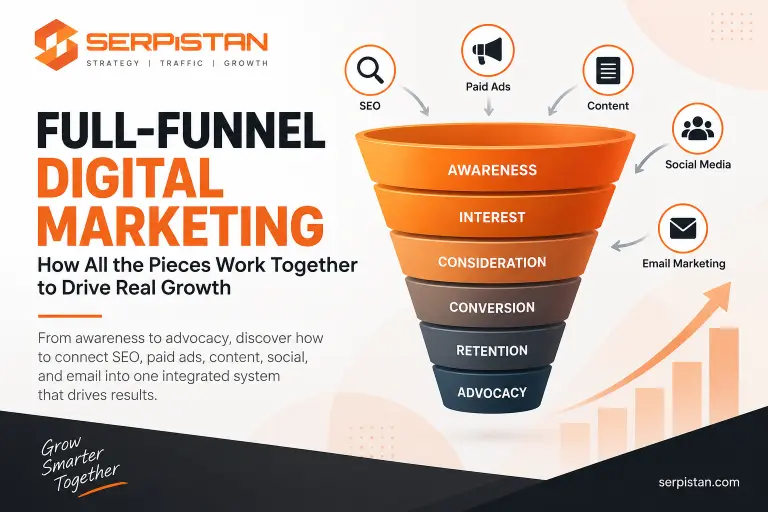
Full-funnel digital marketing is an integrated approach that uses multiple digital marketing channels to attract, engage, convert, retain, and grow customers across different stages of the customer journey. Rather than running SEO, paid advertising, content, social media, and email as isolated projects, each channel is assigned a role based on what a customer needs at a specific point in their decision-making process.
The goal isn’t to use every channel available. It’s to use the right combination of channels to move the right audience toward a specific business outcome, whether that’s a purchase, a signed contract, or a booked consultation.
The funnel is also rarely a straight line in practice. A customer might discover a business through social media, search for it on Google weeks later, read a blog post, see a retargeting ad, visit the site three or four times, sign up for an email list, compare it against alternatives, and convert months after that first social post. Modern customer journeys involve multiple touchpoints across multiple channels, often over an extended period.
The Digital Marketing Funnel Explained
Funnel terminology varies between businesses and marketers, but the underlying customer journey it describes is similar everywhere. Here it’s broken into six stages: awareness, interest, consideration, conversion, retention, and advocacy. Not every business needs to formally track all six. What matters is understanding what a prospect is thinking at each point, and matching your marketing to that.
Awareness
The customer doesn’t know your business, and may not fully recognize their own problem yet
The business goal here is reach, not conversion. Channels like SEO, social media, video, display advertising, paid search, content marketing, and digital PR all work at this stage, typically through educational, problem-focused content: blog posts, guides, videos, and industry research rather than product pitches.
Interest
The customer understands the problem and is actively researching potential solutions
Educational content, SEO, retargeting, social media, email capture, webinars, guides, and lead magnets all help a prospect understand their options in more depth at this stage. No single engagement metric here should be treated as proof of purchase intent.
Consideration
The customer is comparing options and evaluating whether your business is the right fit
This is where uncertainty needs to be reduced. Case studies, testimonials, service pages, comparison content, reviews, demos, webinars, retargeting, email nurturing, and search campaigns all help a prospect feel confident moving forward.
Conversion
The customer is ready to take action, and friction is what stands between them and doing it
Landing pages, conversion rate optimization, paid search, retargeting, email, strong calls to action, checkout flows, and forms all matter here. The goal isn’t more clicks, it’s more completed, meaningful business outcomes.
Retention
The funnel doesn’t end at the sale. This is where marketing gets more efficient over time
Email marketing, customer education, support content, loyalty programs, product education, and upselling all keep existing customers engaged, which is almost always cheaper than acquiring new ones.
Advocacy
Satisfied customers become a source of new growth on their own
Reviews, testimonials, referrals, user-generated content, and referral programs turn existing customers into a channel of their own, often one of the most cost-effective ones a business has.
How Each Channel Fits Into the Funnel
Most channels aren’t limited to one stage. Here’s where each one actually contributes across the funnel, not just where it’s commonly assumed to work.
SEO
SEO is often treated as a top-of-funnel, traffic-only channel, but it can support nearly every stage when content is matched to search intent. Informational searches and educational content drive awareness. Comparison and commercial investigation content supports consideration. Product and service pages with high-intent keywords drive conversion. Support and how-to content aids retention. The mistake isn’t using SEO too much, it’s writing SEO content without considering which stage of intent it’s actually meant to capture.
Paid Advertising
Paid advertising, including PPC and search campaigns, can run awareness campaigns, search campaigns, remarketing, lead generation, and direct conversion campaigns, often simultaneously across different audience segments. Audience segmentation and message alignment matter more than budget size. Paid advertising does not automatically produce immediate conversions, its effectiveness depends heavily on where the landing page and follow-up experience send that traffic.
Content Marketing
Content serves a different purpose at every stage: educational blog posts and videos for awareness, case studies and detailed guides for consideration, product content and FAQs for conversion, and tutorials and knowledge base articles for retention. Serpistan’s content marketing work is built around matching content type to where a reader actually is in their decision, not producing content for its own sake.
Social Media
Social media contributes to awareness, engagement, community building, consideration, retargeting, retention, and advocacy, though organic and paid social play different roles. Organic tends to build awareness and community over time, while paid social can target specific audiences at specific funnel stages. Not every business needs the same social strategy, a B2B software company and a local retail business will use the channel very differently.
Email Marketing
Email becomes especially useful the moment a business captures a prospect’s contact information. It supports lead nurturing, educational sequences, promotional campaigns, abandoned cart recovery, onboarding, retention, upselling, and re-engagement, often more cost-effectively than any paid channel, since the audience has already opted in.
Conversion Rate Optimization
Generating traffic is only half the equation. Conversion rate optimization improves landing pages, forms, calls to action, navigation, and checkout experiences, which means it can influence the efficiency of every acquisition channel feeding into it. A 20% lift in landing page conversion rate is often cheaper to achieve than a 20% increase in traffic volume.
How SEO, Ads, Content, and Social Work Together
Here’s a realistic sequence: a prospect sees educational content through social media. Weeks later, they search Google for the problem and find an SEO article. They visit a service page. A retargeting campaign reminds them about the business a few days after that. They download a guide and enter an email sequence. They receive a case study relevant to their situation. They eventually request a consultation.
No single channel gets full credit for that outcome, even though most reporting tools default to crediting whichever channel touched the conversion last. Google’s own guidance on understanding sales journeys and attribution models covers this in more depth: last-click attribution is simple, but it consistently undervalues the channels that started the journey in the first place.
A Full-Funnel Example
Here’s how a hypothetical local service business might map channels across the funnel. This is illustrative, not a claim about any specific client’s results.
| Funnel Stage | Customer Goal | Business Activity | Channels | Example KPI |
|---|---|---|---|---|
| Awareness | Discover a solution | Educational content | SEO, social, paid media | Reach |
| Interest | Learn more | Guides and resources | SEO, content, email | Engagement |
| Consideration | Compare options | Case studies and proof | SEO, email, retargeting | Qualified leads |
| Conversion | Take action | Landing page and offer | Paid search, CRO, email | Conversion rate |
| Retention | Get ongoing value | Education and communication | Email, content | Retention rate |
| Advocacy | Recommend the business | Reviews and referrals | Email, social | Referral revenue |
Building a Full-Funnel Digital Marketing Strategy
- Step 1: Define the business goal. Start with revenue, leads, customers, or retention, not vanity metrics.
- Step 2: Map the customer journey. Understand how prospects actually discover, research, evaluate, and buy.
- Step 3: Identify funnel gaps. Find where customers are dropping out, not just where volume is low.
- Step 4: Assign channels to stages. Choose channels based on customer behavior, not by using everything available.
- Step 5: Create content for each stage. Match content type to search intent and customer need.
- Step 6: Connect campaigns. Coordinate messaging and audiences across channels rather than running each in isolation.
- Step 7: Track the right KPIs. Measure channel performance alongside actual business outcomes.
- Step 8: Test and improve. Use performance data to find bottlenecks and refine the funnel over time.
Common Full-Funnel Marketing Mistakes
- ✕ Treating channels as completely separate. Coordinate messaging and handoffs between channels instead.
- ✕ Focusing only on traffic. Traffic without a conversion path is just spend without an outcome.
- ✕ Relying only on last-click attribution. It systematically undervalues the channels that start the journey.
- ✕ Creating content without a funnel stage in mind. Every piece should have a clear job to do.
- ✕ Running ads to weak landing pages. Fix the destination before scaling the traffic going to it.
- ✕ Ignoring retention. Acquiring a customer is only the first half of the relationship.
- ✕ Using the same message at every stage. An awareness-stage visitor and a ready-to-buy visitor need different things.
- ✕ Tracking too many metrics. A focused set of KPIs beats a dashboard nobody reviews.
- ✕ Optimizing channels instead of the journey. A channel can look efficient on its own while the overall funnel underperforms.
- ✕ Assuming every business needs every channel. Fewer, well-coordinated channels usually beat more, disconnected ones.
Not Sure Where Your Funnel Has Gaps?
Map your current channels against the customer journey before deciding what to add or fix next.
Full-Funnel KPIs by Stage
| Funnel Area | KPIs to Consider |
|---|---|
| Awareness | Reach, impressions, organic visibility, relevant traffic |
| Engagement | Engaged visitors, content engagement, email signups |
| Consideration | Qualified leads, demo requests, consultation requests, assisted conversions |
| Conversion | Conversion rate, CAC, CPL, revenue, ROAS, ROI |
| Retention | Retention rate, repeat purchases, LTV, churn |
| Advocacy | Referrals, reviews, referral revenue |
Select KPIs based on your specific goals and business model rather than tracking every metric on this list at once.
How to Measure Full-Funnel Performance
Looking beyond individual channel metrics means pulling in attribution data, assisted conversions, customer journey analysis, CRM data, and revenue reporting, not just what shows up natively inside Google Analytics or Google Ads individually.
Bringing It Together
Full-funnel digital marketing isn’t about running more campaigns or adding more channels. It’s about recognizing that SEO, paid ads, content, social, and email each play a specific role at a specific point in a customer’s decision, and building a strategy where those roles actually connect. A prospect who sees a coordinated experience across channels, rather than a disjointed set of separately run campaigns, converts more reliably and stays a customer longer.
Start by mapping your own customer journey honestly, then work out where the actual gaps are before deciding what to add.