
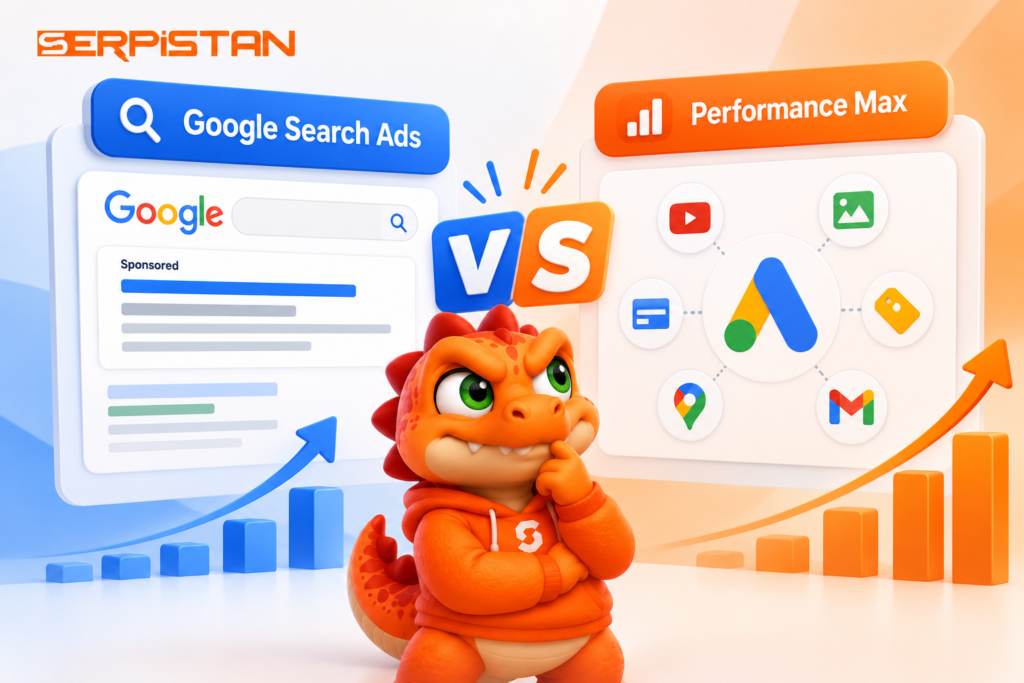
You are about to launch Google Ads, or restructure an account that has grown messy, and one question keeps coming up: should you build around traditional Search campaigns, or hand more of the work to Performance Max?
The core distinction in search ads vs Performance Max is simple to state:
- Search campaigns mainly show text ads in response to relevant queries on Google Search and eligible search-related inventory, based on the keywords and settings you choose.
- Performance Max uses Google’s automation to serve ads across multiple eligible Google channels from a single campaign, guided by your conversion goals, creative assets, audience signals, and conversion data.
This is not a choice between manual and automated advertising. Search campaigns also support automated bidding and other automation features. The real difference is how much of targeting, placement, and creative assembly you control directly versus how much you delegate to Google’s systems.
Search generally suits businesses that want to capture demand from people searching for specific products or services, with direct keyword management. Performance Max is designed to pursue conversion goals across a wider range of Google inventory. Neither is universally better; the right choice depends on your goals, conversion data, creative assets, budget, and how much control you need. Many accounts use both.
Below we compare the two on targeting, control, placements, creative, reporting, and fit for lead generation and ecommerce, then give you a decision framework and a testing process.
Search Ads vs. Performance Max: Key Differences
| Comparison factor | Google Search campaigns | Performance Max |
|---|---|---|
| Primary approach | Ads matched to relevant search queries on Google Search and eligible search inventory | Automated delivery across eligible Google advertising channels from one campaign |
| Core strength | Intent-led search targeting and keyword-level campaign management | Cross-channel reach and automated optimization toward configured conversion goals |
| Targeting inputs | Keywords, match types, negative keywords, location, language, and other settings | Conversion goals, audience signals, search themes, assets, product feeds, and automated targeting |
| Creative requirements | Mainly responsive search ad text (headlines and descriptions) plus relevant landing pages | Multiple asset types, such as text, images, logos, and video, grouped into asset groups |
| Channel reach | Primarily Search and eligible search-related inventory | Search, YouTube, Display, Discover, Gmail, and Maps, where eligible |
| Automation | Supports automated bidding (Smart Bidding) and optional features such as AI Max for Search | Extensive automation across bidding, targeting, placement, and ad assembly |
| Control | More direct control over keyword strategy and search-focused structure | Less direct control over individual placements and delivery decisions |
| Reporting | Search-focused reporting, including search terms where available | Channel performance, asset and asset group reporting, search terms, and placement reports |
| Retail use case | Capture demand for specific products or categories through search | Promote eligible products across channels using a Merchant Center feed and assets |
| Main consideration | Reach depends on relevant search demand and campaign setup | Performance depends on goal quality, tracking, assets, and automated delivery |
Platform features in this table reflect Google’s About Performance Max campaigns documentation at the time of writing. Actual controls, inventory, reporting, and eligibility vary by account and campaign configuration, and Google updates them regularly.
What Are Google Search Ads?
A Google Search campaign shows ads in response to relevant queries on Google Search and eligible search-related inventory, according to the keywords and settings you configure. Its appeal is simple: you reach people at the moment they type a need into Google.
How Search campaigns work
- Keywords and match types. You choose keywords that describe what you offer, and a match type controls how closely a search must relate to them. According to Google’s guide to keyword matching options, broad match (the default) can show ads for related searches, phrase match for searches that include your keyword’s meaning, and exact match for searches with the same meaning or intent.
- Search queries and intent. The actual words people type (search terms) are what trigger your ads, and intent varies: some people are researching, others are ready to buy.
- Ad groups and responsive search ads. Keywords are grouped by theme, each with responsive search ads, where you supply several headlines and descriptions and Google tests combinations.
- Landing pages that match the keyword theme and ad.
- Negative keywords to stop ads showing for irrelevant searches, plus search-term reports to find them.
- Campaign settings such as location, language, budget, and bidding strategy.
- Conversion tracking so bidding and evaluation can focus on real outcomes.
Keywords are not a literal list of the only phrases that trigger your ads. Match types, Google’s interpretation of queries, competition, ad eligibility, and settings all influence when ads appear.
Search is also not a purely manual campaign type. Advertisers can use automated Smart Bidding strategies, and Google now offers optional AI Max for Search campaigns, which adds broader search term matching, automated text customization, and final URL expansion.
What Search campaigns do well
- Reaching people who express a need through relevant searches.
- Building campaigns around specific products, services, and intent.
- Managing keyword themes and negative keywords directly.
- Reviewing search-term data to learn what people actually search for.
- Writing ads and landing pages tightly aligned to each theme.
- Structuring campaigns around business priorities, such as separating high-margin services.
These strengths are especially useful for businesses with defined services, location-based demand, or products people actively search for: an emergency plumber, a B2B software category, or a specific product line.
Search campaign limitations
- Reach is capped by relevant search demand. If few people search for your solution, Search cannot create that demand.
- Competitive keywords can be expensive.
- Keyword, negative keyword, and ad management need ongoing attention.
- Search may miss customers who would discover your offer through video, display, or other placements.
- Results suffer from poor conversion tracking, weak landing pages, or insufficient demand.
Search does not only reach people who are ready to buy. Many searches are early research, so intent should be judged query by query.
What Is Performance Max?
Performance Max is a goal-based Google Ads campaign type that uses automation to serve ads across Google’s advertising inventory from a single campaign. Google’s About Performance Max campaigns page lists YouTube, Display, Search, Discover, Gmail, and Maps among the channels it can reach, and describes it as a complement to keyword-based Search campaigns for advertisers with specific conversion goals.
Instead of choosing keywords and placements yourself, you supply goals, budget, bidding, creative assets, audience signals, and (for retail) a product feed. Google’s systems then decide where, when, and to whom ads are shown.
Audience signals are guidance, not limits. They help the system learn faster by pointing it toward people likely to convert, but the campaign can still show ads to people outside those audiences.
How Performance Max campaigns work
- Campaign objectives and conversion goals: the outcomes the campaign optimizes toward.
- Bidding strategy and budget: typically conversion- or value-based bidding.
- Asset groups: collections of headlines, descriptions, images, logos, and videos built around a theme or audience. Google combines them into ads for each placement.
- Audience signals and search themes: inputs that guide automation. Google says search themes carry the same priority as phrase and broad match keywords.
- Product feeds from Google Merchant Center for eligible retail campaigns.
- Conversion tracking: the data the system learns from.
- Automated placement and bidding decisions across eligible channels.
- Reporting: asset and asset group reporting, channel performance, placement reports, and a search terms report.
Available features depend on campaign setup, account eligibility, and Google’s current capabilities.
What Performance Max does well
- Reaches multiple Google channels from one campaign.
- Automates bidding and placement toward your configured goals.
- Combines many creative assets into formats suited to each placement.
- Can find conversion opportunities outside your existing keyword lists.
- Integrates product feeds for eligible ecommerce advertisers.
- Reduces the need to build and manage separate campaigns for every placement.
These are potential benefits. Whether they appear in your account depends on your goals, data, and inputs.
Performance Max limitations
- Less direct control over individual placements and some delivery decisions than in narrowly configured campaigns.
- Heavy dependence on inputs: conversion tracking, goals, assets, and feed quality.
- More interpretation needed: diagnosing performance across many channels is harder than reading a single Search campaign.
- Optimizes toward what you tell it: if conversion actions are poorly defined (for example, counting every page view as a conversion), the system will chase the wrong result efficiently.
- Weak creative or product data limits results.
- Incrementality is hard to judge from campaign-reported conversions alone, especially when some conversions come from people already searching for your brand.
Google has steadily added reporting and controls. In an April 2025 announcement, it introduced channel performance reporting and full search terms reporting for Performance Max. Check what is currently available in your account before assuming a limitation still applies.
Search Ads vs. Performance Max: Which Gives You More Control?
Control is the biggest practical difference between the two. In general, Search gives you more direct control over which searches you target; Performance Max gives you control over inputs and goals, while Google controls more of the delivery.
Keyword and search-term control
In a Search campaign you organize keyword themes into ad groups, choose match types, add negative keywords, and review the search terms report to see which queries triggered ads. Even so, Google’s matching systems interpret queries, so a keyword does not work as a strict one-to-one trigger, especially with broad match or AI Max turned on.
In Performance Max, search themes and other inputs guide automation but are not a complete list of the only queries the campaign can reach. Google’s documentation on the Performance Max search terms report explains that you can now see which search terms triggered your ads, along with landing pages and headlines, and that negative keywords can be applied at account or campaign level for Search and Shopping inventory. Negative keywords do not cover display and video placements, which use content suitability exclusions instead.
Google also states that when a search query matches an exact match keyword in a Search campaign, that Search campaign is prioritized over Performance Max. This gives advertisers a way to keep their most important exact-match terms in Search.
Placement and creative control
Search campaigns focus on search ad formats, so you write the headlines and descriptions and choose the landing pages. Performance Max distributes your assets across eligible inventory and assembles them into different formats, such as a YouTube video ad, a Display banner, or a Search text ad.
Creative control and placement control are different things. With Performance Max you control the inputs (which assets you supply and how asset groups are themed), but you do not choose exactly where every impression appears. Use the available asset, channel performance, and placement reports to check what is being shown and where.
Search Ads vs. Performance Max for Lead Generation
For businesses that want enquiries, appointments, demos, or consultation requests, the choice hinges on search demand, conversion data, and lead quality.
When Search may be a strong starting point
- Customers actively search for the service (for example, “commercial cleaning company Manchester”).
- You can identify clear commercial-intent keyword themes.
- You serve a defined geography.
- You need close oversight of the queries you pay for.
- Conversion volume is limited, so a focused test is easier to evaluate.
These conditions make Search a practical first step, not a universally better option.
When Performance Max may be worth testing
- You have a reliable conversion goal.
- Conversion tracking is set up and tested.
- There is enough relevant conversion data to evaluate results.
- You want to explore Google inventory beyond Search.
- You can supply useful creative assets and relevant landing pages.
- The campaign can tell valuable leads apart from low-quality enquiries.
That last point matters most. If the campaign optimizes for raw form submissions and many of those submissions are spam or poor fits, automation will happily find more of them. Where possible, feed lead quality back to Google Ads. Google supports offline conversion imports and enhanced conversions for leads, which let you report outcomes such as qualified leads or closed deals from your CRM. Make sure any setup handles customer data in line with your privacy obligations and consent requirements.
Search Ads vs. Performance Max for Ecommerce
In ecommerce, the two campaign types often play different roles in the same account.
Search campaigns for product and category demand
Search can target queries related to your products, brand, categories, or specific shopping needs, such as “waterproof hiking boots women”. Results depend on search intent, product-page relevance, price competitiveness, and accurate conversion tracking.
Performance Max for product promotion across channels
Eligible retailers can connect a Google Merchant Center product feed and campaign assets so Performance Max promotes products across Search, Shopping placements, YouTube, Display, and other eligible inventory.
Feed quality is critical: accurate product titles, descriptions, images, prices, availability, and landing pages all influence where and how products appear. A good feed is an input, not a guarantee of profitable sales.
How to compare the results fairly
When comparing Performance Max for ecommerce with Search, review:
- Conversion value and attributed revenue.
- Advertising spend.
- Cost per acquisition.
- Return on ad spend, where revenue tracking is reliable.
- New-customer performance, where it is reliably measured.
- Product-level and margin-level economics.
- Brand versus non-brand demand, where available.
- Overlap, and conversions that might have happened without the campaign.
Platform-reported conversions and ROAS do not on their own prove incremental business impact. A campaign that captures many branded searches may look highly efficient while adding few sales you would not have made anyway.
Can You Run Search Ads and Performance Max Together?
Yes. Advertisers can run both campaign types in the same account, and Google positions Performance Max as a complement to Search. It works best when there is a clear strategy and measurement plan.
Running both does not automatically mean they will compete destructively, and neither always wins. Which campaign serves for a given query depends on Google’s systems and your configuration, although Google says Search campaigns take priority when a query matches an exact match keyword.
Practical approaches:
- Use Search to manage your most important search-intent themes directly.
- Use Performance Max to pursue additional opportunities across eligible inventory.
- Review search-term and channel reports to understand what traffic each campaign generates.
- Check for overlapping goals, duplicated conversion actions, or confusing structures.
- Use negative keywords and brand exclusions where supported to keep roles clear.
- Judge account-level business outcomes, not each campaign in isolation.
Running both does not guarantee more conversions or lower costs. Their combined value needs to be measured, ideally with an experiment (covered below).
Budget, Bidding, and Conversion Data: What Should You Consider?
There is no universal budget split between Search and Performance Max. Google ads budget allocation should follow your goals, economics, available demand, and evidence. Consider:
- Whether there is enough relevant search volume for Search to scale.
- Whether conversion tracking is reliable.
- Whether campaign goals reflect real business outcomes, such as qualified leads or profitable sales.
- Your sales cycle, and how long you need to judge results fairly.
- Whether the budget can support a meaningful test, rather than a few days of thin data.
- The cost and quality of the leads or customers acquired.
- Whether you have suitable creative assets (especially images and video for Performance Max).
- How much management and analysis time your team can give.
Search campaign bidding and Performance Max can both use automated bidding. The difference is scope: Performance Max automates more aspects of delivery, including where ads appear and how assets are combined, across all of its eligible inventory.
Common Mistakes When Choosing Between Search and Performance Max
- Choosing a campaign type before defining the conversion goal. Fix: decide what a valuable outcome is first, then choose the campaign type that can pursue it.
- Comparing campaigns that optimize toward different outcomes. Fix: compare like with like, using the same conversion actions and attribution settings.
- Using incomplete or duplicated conversion tracking. Fix: audit conversion actions, remove duplicates, and test every key action before launching.
- Assuming more automation means better performance. Fix: treat automation as a tool that amplifies the quality of your inputs, good or bad.
- Treating Search as entirely manual. Fix: consider Smart Bidding and optional features like AI Max where they suit your goals and data.
- Expecting Performance Max to work without good assets or product data. Fix: supply varied, relevant assets and maintain an accurate Merchant Center feed.
- Optimizing lead campaigns for volume without checking quality. Fix: track qualified leads and, where possible, import offline outcomes.
- Comparing reported ROAS without considering margins and attribution. Fix: assess product margins and look at contribution, not just revenue.
- Deciding from too little data. Fix: set an evaluation period that reflects your sales cycle and conversion volume.
- Assuming reported conversions are incremental. Fix: use experiments or other controlled measurement before crediting a campaign with all reported sales.
A Simple Decision Framework: Which Campaign Type Should You Choose?
| Consider starting with Search if… | Consider testing Performance Max if… | Consider using both if… |
|---|---|---|
| Customers actively search for your product or service | You have a clear, reliably tracked conversion goal | Search demand is important to your business |
| You can identify relevant search-intent themes | You want to explore Google channels beyond Search | Extra cross-channel reach may add incremental value |
| You need direct control over keywords and queries | You can supply suitable creative assets or a product feed | You can set clear goals and evaluate combined account results |
| You have a clear landing page and conversion action | You have enough data and budget to evaluate it meaningfully | Your budget and measurement support a fair comparison |
| You want to validate demand with a focused campaign | You can monitor lead quality, revenue, or other real outcomes |
These are starting points, not fixed rules. A local service business with strong search demand and modest budget will often start with Search. An ecommerce brand with a healthy feed, good visual assets, and solid conversion data may lead with Performance Max and use Search for key product terms. Your own circumstances may call for a different structure.
How to Test Search and Performance Max Without Guessing
- Define the business outcome you will measure, such as qualified leads, sales, or contribution.
- Audit conversion tracking and attribution settings.
- Establish a baseline from existing account and business data.
- Choose campaign types based on your demand, goals, and resources.
- Use budgets large enough for a meaningful test and keep measurement definitions consistent.
- Avoid changing several major variables at once.
- Evaluate over a period that reflects your sales cycle and conversion volume.
- Compare qualified leads, sales, revenue, or contribution where the data allows.
- Consider overlap and incrementality before crediting one campaign with all reported results.
- Document what you learn and adjust based on evidence.
Comparing two campaign reports side by side does not prove that one campaign generated additional sales. For a more reliable answer, use a controlled test. Google offers Performance Max experiments, including uplift experiments that measure the additional conversions or conversion value Performance Max adds when run alongside your existing campaigns.
When Should You Get Help With Google Ads Strategy?
Many businesses manage straightforward campaigns in-house when they have the skills, clear goals, and reliable measurement.
Professional support may help when you need guidance on campaign architecture, keyword strategy, Performance Max setup, product-feed quality, conversion tracking, lead qualification, reporting, or budget allocation.
Frequently Asked Questions
What is the difference between Search Ads and Performance Max?
Search campaigns show ads for relevant searches based on the keywords and settings you choose. Performance Max uses automation to show ads across multiple Google channels, including Search, YouTube, Display, Discover, Gmail, and Maps, from one campaign, guided by your goals and assets.
Is Performance Max better than Search Ads?
Not universally. Performance Max can reach more inventory and automate more decisions, while Search offers more direct keyword control. Which performs better depends on your goals, conversion data, assets, budget, and how results are measured.
Can you run Search and Performance Max together?
Yes. Many advertisers use both, with Search covering key search-intent themes and Performance Max seeking additional opportunities. Google prioritizes Search campaigns when a query matches an exact match keyword. Measure combined account results rather than each campaign alone.
Is Performance Max good for lead generation?
It can be, when conversion tracking is reliable and the campaign optimizes for qualified leads rather than raw form fills. Importing lead quality or closed-deal data from your CRM helps the system find better prospects.
Is Performance Max suitable for ecommerce?
Often, for eligible retailers with an accurate Merchant Center feed and good creative assets. Results still depend on feed quality, pricing, margins, and measurement.
Which Google Ads campaign type gives you more control?
Search campaigns give more direct control over keywords and search queries. Performance Max offers control over goals, assets, signals, and some exclusions, but Google makes more of the placement and delivery decisions.
How should you compare Search and Performance Max results?
Use the same conversion actions and attribution settings, compare business outcomes such as qualified leads, sales, and contribution, and use experiments to test incrementality rather than relying only on campaign-reported conversions.
Conclusion:
Search offers a search-focused approach with direct keyword management. Performance Max uses automation to pursue conversion goals across eligible Google advertising channels. Both can work well, and many accounts benefit from using them together.
The best choice depends on your search demand, conversion goals, tracking quality, budget, creative assets, and business economics. Start with a clear goal, choose the structure that fits your situation, and measure success through meaningful business outcomes rather than assumptions about automation or control.