
GUIDE
14 MIN READ
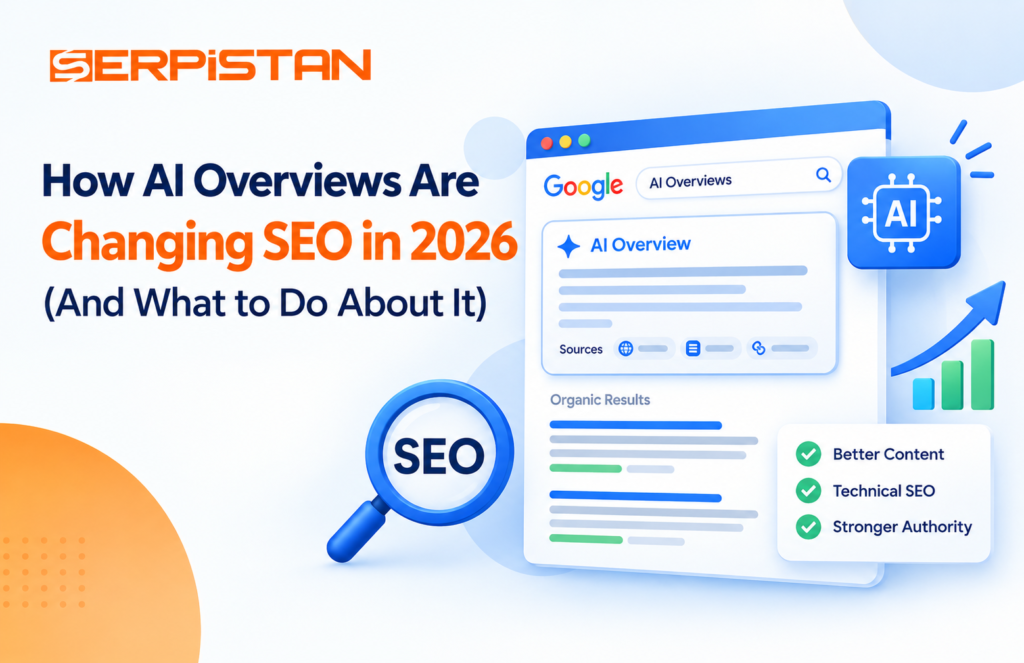
Search used to look fairly simple: query, search results, click, website. Increasingly, it looks more like: question, AI-generated overview, supporting sources, follow-up exploration. Google describes AI Overviews as providing “a snapshot of key information… with links to dig deeper” (Google Search Central: AI features in Search ↗).
That shift matters to businesses in a few concrete ways. Some users may get useful information without immediately clicking a traditional result. Search journeys are becoming more conversational and exploratory. More complex questions get handled within the search experience itself. Websites have new opportunities to appear as cited or linked sources within AI-generated answers. And measuring organic search success through clicks and rankings alone is becoming less complete.
What Are Google AI Overviews?
AI Overviews are Google’s AI-powered search feature that generates a synthesized answer for certain eligible queries, paired with links users can follow to learn more. They don’t appear for every query; Google surfaces them when it determines an AI-generated summary would genuinely help.
| Traditional Search Results | AI Overview |
|---|---|
| List of organic results, ads, and search features | AI-generated synthesis of information |
| User chooses which result to open | Draws on multiple sources at once |
| One click, one destination | Supporting links the user can continue exploring from |
AI Overviews vs. AI Mode
These are related but distinct features, and Google’s documentation groups them together when explaining how websites can appear within its generative AI search experiences.
AI Overviews appear directly within regular Google Search results for eligible queries, providing an AI-generated summary alongside supporting links, without requiring the user to leave the familiar search results page.
AI Mode provides a more conversational, exploratory search experience built for follow-up questions and more complex, research-style interactions, closer to a back-and-forth than a single search query.
Both features have grown quickly. Google announced at its I/O 2026 event that AI Overviews had surpassed 2.5 billion monthly active users, while AI Mode had passed 1 billion monthly users roughly a year after launch, with query volume reportedly more than doubling every quarter since it shipped (SEO Worth: Google AI Mode passes 1 billion monthly users ↗; Dataconomy: AI Overviews surpasses 2.5 billion monthly users ↗). That scale is why this topic deserves attention, not because it signals the end of conventional search.
The Biggest SEO Change: Search Results Are Becoming More Answer-Oriented
The strategic shift is moving from “ranking for a keyword” toward “being useful enough to be surfaced when Google synthesizes an answer.” That’s a real change in emphasis, but it’s not a separate algorithm.
What changes is the strategic emphasis: relevance, clear answers, original information, first-hand experience, trust, strong topical coverage, useful supporting detail, and crawlable, indexable content all matter more when the baseline, generic information, is something Google’s systems can increasingly synthesize on their own.
1. Traditional SEO Fundamentals Still Matter
This is the single most important point in this guide. Google’s AI-feature documentation states plainly that the same SEO fundamentals that apply to traditional Search also apply to AI Overviews and AI Mode: crawlability, indexability, search intent, helpful content, relevant content, clear site architecture, internal linking, page experience, mobile usability, accurate titles, structured data where appropriate, and strong technical foundations.
Don’t build a separate “AI SEO” checklist and quietly abandon conventional SEO. Build strong SEO foundations first, then make the content more useful and differentiated. The order matters: differentiated content on a technically broken or unindexed site still won’t be found.
2. Generic Content Has Less Strategic Value
When a search engine can synthesize a basic answer itself, content that simply defines common terms, repeats information available everywhere, rewrites competitors, produces shallow summaries, or adds little original insight faces a harder path to being genuinely useful, let alone surfaced as a worthwhile supporting link.
Content with original research, first-hand experience, expert commentary, unique examples, proprietary data, case studies, detailed processes, original frameworks, and real-world observations occupies a different category entirely. Google’s people-first content guidance has long emphasized originality, effort, accuracy, and content that provides unique information or perspectives, and that emphasis matters more, not less, as generic answers become easier for search engines to generate on their own.
3. First-Hand Experience Matters More
Experience can become a real competitive advantage in an AI-assisted search environment. Consider the difference between “Here are five ways to improve Google Ads” and “We tested five Google Ads optimization approaches across these campaigns, and here’s what actually happened.” Or between “How much does a website cost?” and “We analyzed the actual cost components behind 50 website projects and found these patterns.”
First-party evidence differentiates a site from generic information in a way a synthesized summary can’t easily replicate. To be clear, Google hasn’t published “first-hand experience” as a standalone AI Overview ranking factor; this is a practical way to create more useful, original, and trustworthy content that aligns with Google’s existing people-first guidance, not a newly discovered algorithmic lever.
4. E-E-A-T Becomes More Important as Content Becomes Easier to Generate
Experience, Expertise, Authoritativeness, and Trustworthiness matter more in an environment where generic content is cheap to produce at scale. The important distinction to hold onto: E-E-A-T itself is not a specific ranking factor. Google’s own guidance states that its systems “use a mix of factors that can identify aspects of E-E-A-T,” with trust being the most important of the four (Google Search Central: Creating helpful content ↗).
Practical ways to demonstrate trust include clear authorship, relevant expertise, genuine first-hand experience, transparent company information, accurate claims, sources and citations, case studies, clear editorial standards, and corrections or updates where appropriate.
5. Topical Depth Matters More Than Keyword Repetition
Stop thinking about SEO as keyword, article, rank. Think instead in terms of topic, search intents, questions, supporting evidence, and a useful content ecosystem built around a subject your business genuinely knows well.
That means building topic clusters, supporting pages, internal linking between them, coverage of related questions, both commercial and informational intent, and genuine entity relationships, rather than one isolated article per keyword. Publishing a fixed number of articles doesn’t guarantee topical authority; comprehensive, genuinely useful coverage does.
6. Long-Tail and Complex Queries May Become More Valuable
Conversational and multi-part searches create opportunities for businesses willing to answer specific questions thoroughly. Instead of targeting only “website redesign,” consider the related questions people actually ask: How much does a website redesign cost? How long does it take? What should you fix before redesigning? Will it hurt SEO? How do you migrate SEO during a redesign?
The goal isn’t producing thousands of pages for every conceivable query. It’s understanding the questions your customers actually have and building genuinely useful resources around them.
7. Original Data Can Become a Competitive Advantage
Case studies, surveys, customer research, industry data, internal benchmarks, experiments, original analyses, proprietary tools, calculators, visualizations, and first-party observations are all content assets that competitors can’t easily reproduce. That difficulty is exactly what makes them valuable: original information is harder to copy and makes a page more valuable as a source, connecting directly to Google’s guidance around original information, research, and analysis as markers of helpful content.
8. Being Cited or Linked Is Not the Same as Getting a Click
Here’s a real measurement challenge: a page might appear in an AI Overview, be linked as a supporting source, influence a user’s understanding of a topic, receive a click, receive no click at all, later produce a branded search, or contribute to a conversion through an entirely different channel. Not every appearance in an AI-generated answer produces brand value or revenue, and it would be a mistake to assume otherwise.
The practical response is to broaden the measurement framework rather than fixate on any single metric: organic impressions, organic clicks, branded search growth, organic conversions, assisted conversions, qualified leads, revenue, and visibility in AI features where that reporting is actually available.
9. Search Console Measurement Is Evolving
Google continues to develop how it reports on performance within generative AI features. In September 2026, Google introduced web multimodal search reporting in Search Console, adding a filter that distinguishes “text-based” from “multimodal” web search results, covering experiences involving Google Lens, Circle to Search, image uploads, and Chrome’s “Search this image” feature (Search Engine Roundtable: Google Search Console multimodal search type filter ↗).
SEO teams should pay attention to emerging Search Console reporting rather than relying solely on traditional keyword and click reports, while being careful not to assume capabilities Search Console doesn’t actually expose. Reporting in this area is still developing, so verify exact capabilities against current documentation before building a measurement plan around them.
10. Visual and Multimodal Search Matter More
SEO is increasingly broader than text alone. Images, product photography, diagrams, video, and visual explanations all factor into how people search now, through image search, Google Lens, Circle to Search, and other multimodal queries, a trend directly reflected in Search Console’s new multimodal reporting.
Practical steps: use genuinely useful and relevant images, write descriptive alt text, provide surrounding textual context, optimize image quality and accessibility, create original visual assets where they add real value, and make product and location imagery authentic rather than generic stock photography. Adding more images doesn’t automatically improve rankings; adding genuinely useful ones supports the broader experience.
11. Brand and Source Trust Matter
Being a recognizable, trustworthy source becomes more valuable in an environment where users increasingly encounter synthesized answers rather than a list of links to evaluate individually. Clear company identity, author information, a real about page, contact information, transparent business details, consistent demonstrated expertise, reputation, original content, and strong customer evidence all contribute to this.
Google now lets users select preferred sources, websites a person has specifically chosen to see favored in their results, and has extended that preferred-source functionality into AI Mode and AI Overviews as well (PPC Land: Google brings preferred sources into AI Overviews and AI Mode ↗). Treat this as an emerging way for users to signal which publishers they trust, not as an SEO tactic that guarantees higher rankings on its own.
12. Structured Data Still Has a Role, But It Is Not “AI Optimization”
Structured data helps Google understand page content and can make pages eligible for certain supported search features.
Do: use supported structured data where it genuinely applies, keep it accurate, match markup to visible page content, and follow Google’s guidelines.
Don’t: add irrelevant schema, expect schema to guarantee AI Overview inclusion, or treat it as a secret generative-AI ranking hack.
Google’s current AI-feature guidance doesn’t require special schema specifically for AI Overviews or AI Mode; the same structured data principles that apply to traditional search still apply here.
13. Technical SEO Still Determines Whether Content Can Be Found
AI search doesn’t eliminate the need for solid technical SEO. Crawling, indexing, canonicalization, robots directives, XML sitemaps, internal links, HTTP status codes, JavaScript rendering, mobile accessibility, and HTTPS all still matter, because Google confirms that a page must be “indexed and eligible to be shown in Google Search with a snippet” before it can even be considered as a supporting link in AI Overviews or AI Mode.
The strategic message is simple: if search engines can’t properly access, understand, or index your content, better AI-focused writing won’t solve the underlying problem.
14. Page Experience Still Matters
AI search doesn’t make website usability irrelevant. Google says its core ranking systems “look to reward content that provides a good page experience,” while also emphasizing that “there is no single signal” for page experience, just “a variety of signals that align with overall page experience” (Google Search Central: Understanding page experience ↗).
Core Web Vitals, mobile usability, HTTPS, the absence of intrusive interstitials or excessive ads, readability, navigation, and overall usability all remain part of this picture. Importantly, Google explicitly states that good Core Web Vitals scores don’t guarantee top rankings, so treat page experience as a contributing factor, not a silver bullet, in an AI-driven search landscape or otherwise.
15. SEO Content Needs to Become More Useful Than the Search Summary
This is the central editorial challenge: why would someone need to visit your page if Google can already summarize the basic answer? The honest answers are the same ones that have always made content genuinely valuable: you have original data, first-hand experience, or proprietary information; you explain the topic better than a summary can; you provide a useful tool, detailed examples, or expert analysis; you answer the questions that naturally follow the first one; you provide an actual product or service; or your information simply can’t be fully summarized without losing something that matters.
That question, “why would someone need to visit this page specifically,” deserves to sit at the center of content strategy going forward.
What NOT to Do for AI Overviews
Google has been direct about this: there are no additional technical requirements or special optimizations required to appear in AI Overviews or AI Mode. Anyone selling a formula for guaranteed AI Overview placement is selling something Google’s own documentation says doesn’t exist.
What to Do About AI Overviews: A Practical 2026 SEO Strategy
Step 1: Audit your existing organic winners. Identify pages already generating organic traffic, leads, revenue, strong engagement, or high-intent visits. Don’t automatically replace them with new AI-focused content just because the search landscape is changing.
Step 2: Identify commodity content. Find pages that merely repeat information already available everywhere, and ask honestly: what does this page provide that another website couldn’t easily reproduce? If the answer is nothing, it needs improvement.
Step 3: Add first-hand evidence. Where genuinely appropriate, add original data, screenshots, case studies, examples, expert commentary, documented processes, real results, and customer insights.
Step 4: Strengthen trust signals. Review authors, credentials, your about page, contact information, sources, editorial standards, and overall business identity.
Step 5: Improve internal linking. Build real relationships between core commercial pages, informational content, supporting guides, case studies, and product or service pages.
Step 6: Improve technical accessibility. Audit crawling, indexing, canonicals, robots directives, sitemaps, internal links, and mobile experience.
Step 7: Measure business outcomes. Don’t stop at “we appeared in AI search.” Track qualified traffic, leads, sales, revenue, branded demand, organic conversions, and relevant Search Console data.
Step 8: Monitor how search is changing. Review current Search Console reports, Google Search documentation, AI Overview and AI Mode developments, multimodal search changes, and search appearance updates regularly, rather than building a long-term strategy on information that may already be outdated.
AI Overviews and the Future of SEO
The most durable SEO principles are likely to remain the ones that make a website genuinely useful: relevance, originality, experience, expertise, trust, technical accessibility, good page experience, strong information architecture, and real business value. None of that is new, even as the search experience around it keeps evolving.
What this guide won’t do is predict the exact future share of search traffic that will come from AI Overviews, or make claims like “AI Overviews will replace organic search,” “clicks will disappear,” “traditional SEO is dead,” or “everyone must completely rebuild their SEO strategy.” Search is evolving, not predetermined, and the businesses that adapt well tend to be the ones paying attention to actual documentation and their own data rather than reacting to whichever claim is loudest this quarter.
How Serpistan Can Help
Serpistan can help businesses adapt their SEO strategy to the changing search landscape through SEO audits, technical SEO work, content strategy, keyword research, content optimization, internal linking, and organic performance reporting that connects SEO work to measurable business outcomes.
Want help figuring out where your content stands and what’s worth prioritizing as search continues to evolve? Serpistan’s SEO services can help evaluate your current strategy, and case studies show documented examples of past client work. This isn’t a promise of AI Overview placement; it’s a commitment to building organic visibility that holds up as search keeps changing.
Frequently Asked Questions
What are AI Overviews?
AI Overviews are Google’s AI-generated search summaries that provide a synthesized answer for certain eligible queries, along with supporting links users can follow to learn more.
Are AI Overviews replacing SEO?
No. Google states directly that existing SEO fundamentals remain relevant for AI Overviews and AI Mode, and that there are no additional technical requirements or special optimizations needed to appear in them.
How do I optimize my website for AI Overviews?
There’s no separate, special optimization requirement. Focus on strong SEO fundamentals: technical accessibility, useful and original content, clear site structure, and genuine trust signals, the same foundation that supports traditional search performance.
Do backlinks still matter with AI Overviews?
Yes, relevant and authoritative backlinks still contribute to credibility and authority. There’s no evidence that backlinks guarantee AI Overview visibility specifically; they remain one part of a broader authority picture.
Does E-E-A-T matter for AI Overviews?
E-E-A-T concepts, particularly trust, remain relevant to the broader goal of helpful, reliable content. E-E-A-T itself is not a specific ranking factor; Google’s systems use a mix of other factors that can identify aspects of it.
Will AI Overviews reduce organic traffic?
The effect can vary significantly by query type, search experience, website, industry, and user behavior. There’s no universal, verified traffic-loss percentage that applies across every website, so be cautious of any source presenting one as settled fact.
Can my website appear as a source in an AI Overview?
Google can surface relevant, eligible links within AI Overviews and AI Mode, provided a page is indexed and meets standard Search technical requirements. There’s no guaranteed inclusion mechanism, and no legitimate way to force inclusion.
Does schema markup help with AI Overviews?
Google doesn’t require special schema for AI Overviews. Structured data primarily helps Google understand eligible content and qualify pages for supported search features generally, not AI Overviews specifically.
Should I create content specifically for AI Overviews?
No. Create content for people first, making it useful, original, trustworthy, and technically accessible, rather than writing specifically to try to manipulate AI-generated results.
How should I measure SEO performance in 2026?
Look beyond clicks and rankings alone. Track organic visibility, qualified traffic, conversions, revenue, branded search demand, and current Search Console reporting, including newer reporting on AI and multimodal search as it becomes available.