
Updated May 2026
15 min read
A growing business eventually hits the same wall: marketing needs have outgrown what one person or one small team can handle. There is no universally correct answer between hiring internally and partnering with an agency. Here is how to actually decide.
Scaling SEO-driven revenue for 400+ businesses across the USA, UK, Canada, and Dubai · On-page and off-page SEO expert at Serpistan
In-House Team vs. Agency: Quick Comparison
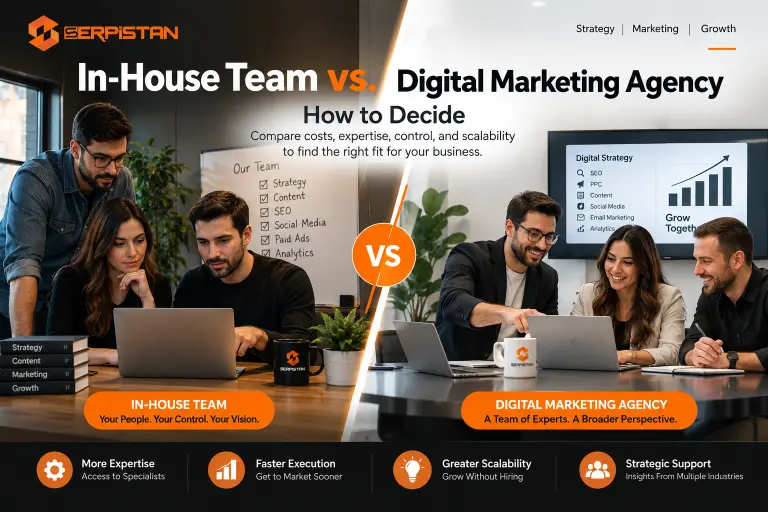
The right choice depends on your budget, business size, required expertise, speed of execution, hiring ability, internal management capacity, and how much your marketing needs are likely to change. This table is a starting point, not a rule.
| Factor | In-House Team | Digital Marketing Agency |
|---|---|---|
| Initial hiring | Higher | Lower |
| Ongoing staffing | Business manages | Agency manages |
| Expertise | Depends on hires | Access to multiple specialists |
| Control | High | Moderate |
| Scalability | Requires hiring | Generally easier to scale |
| Speed to launch | Can take time | Often faster |
| Management | Internal | Shared with agency |
| Tools and technology | Business provides | Often included or available |
| Industry experience | Based on internal team | Agency may bring cross-client experience |
| Flexibility | Depends on team capacity | Often broader service capacity |
| Institutional knowledge | High | Must be developed |
| Specialized expertise | Requires hiring | Often available across the agency |
What Is an In-House Digital Marketing Team?
An in-house digital marketing team is made up of employees who work directly for your company and focus solely on your marketing. This can range from a single generalist handling everything to a full department with dedicated specialists across SEO, paid media, content, social, email, analytics, and design. Most businesses do not need every role at once. A small business might start with one generalist, while a larger company builds out a full department over several years as marketing volume grows.
Advantages of an In-House Team
Greater direct control. Internal marketers report directly to leadership, meaning faster alignment and fewer approval layers between an idea and execution.
Deeper business knowledge. Employees inside the company build a real understanding of the product, customers, brand voice, and sales cycle over time.
Faster internal communication. A marketer sitting in on product or sales discussions can react in real time, with no outside coordination needed.
Long-term institutional knowledge. What an in-house employee learns stays inside the company rather than leaving with a contract.
Dedicated attention. An internal hire is focused entirely on your business, not splitting time across other clients.
Disadvantages of an In-House Team
Hiring costs. Recruiting takes time and money, from job postings to interview hours to the cost of a role sitting open for months.
Salaries and benefits. True employment cost goes well beyond salary once insurance, taxes, PTO, and equipment are included.
Recruiting specialized talent. Finding experienced specialists across SEO, PPC, content, and analytics all at once is difficult and expensive.
Training and management. Onboarding, performance management, and professional development all fall on the business.
Limited skill coverage. A small team, however talented, cannot realistically be expert-level in every discipline.
Scalability. Expanding capabilities usually means hiring again, with all the same costs and delays.
It would be inaccurate to claim in-house teams are always more expensive than agencies. Total cost depends heavily on team size, local salary benchmarks, tools, management overhead, and what the business actually needs.
What Is a Digital Marketing Agency?
A digital marketing agency is an outside company hired to handle some or all of a business’s marketing work, sometimes as a full replacement for an internal team and sometimes as an extension of one. Agencies can provide combinations of SEO, paid advertising, content marketing, social media, email marketing, conversion rate optimization, analytics, strategy, web development, and creative services. Many businesses researching this option are really asking whether a broader Digital Marketing Services partnership makes more sense than building each function internally one hire at a time.
Agency capabilities vary enormously from one firm to the next. Some are generalists offering a bit of everything, others specialize deeply in one channel, one industry, or one type of client. Evaluating a specific agency’s actual track record matters far more than evaluating “agencies” as a category.
Advantages of a Digital Marketing Agency
Access to multiple specialists. An agency can put an SEO specialist, a paid media buyer, and a content strategist on your account without you hiring or managing any of them directly.
Faster access to expertise. Rather than spending months building a department, businesses can often start working with experienced people within weeks.
Scalability. Agencies may expand or reduce scope as needs change, without requiring new hires or layoffs to match.
Broader experience. Working across multiple clients and industries often builds pattern recognition a single internal hire would not have had the chance to develop. Industry benchmarking resources like HubSpot’s marketing industry research illustrate how much campaign performance varies by sector, which is part of what that cross-client experience helps an agency navigate. This does not mean every agency has experience in every industry.
Technology and tools. Many agencies already use platforms like Google Analytics and reporting systems as part of daily operations. Whether these are included in your fee varies by agency.
Reduced recruitment burden. The agency handles its own hiring and professional development, not you.
Disadvantages of a Digital Marketing Agency
Less direct control. Because the team is external, businesses typically have less minute-to-minute control over execution.
Communication challenges. Working with an outside team introduces more structure, whether that’s check-ins, approvals, or extra steps between question and answer.
Learning curve. An agency needs real time to understand your business, audience, and goals before performing at its best.
Multiple clients. Agencies manage more than one account. Understand upfront how the agency allocates time across its roster.
Agency costs. Fees can be substantial and vary widely by scope, complexity, market, and agency expertise.
In-House vs. Agency: Which Costs More?
The honest answer is that it depends, and the comparison only makes sense when you look at total cost, not the headline number.
Expertise, Scalability, Control, Speed, and Flexibility
Expertise
In-house teams develop deep, specific company knowledge over time. But a single internal hire cannot realistically cover every discipline at an expert level, whether that’s technical SEO strategy work, paid media, or content all at once. Agencies can provide multiple specialists under one relationship, though an experienced internal team with the right resources can still outperform an agency when deep product knowledge matters more than channel breadth.
Scalability
Growing in-house capabilities generally means hiring again, and every new channel often requires a new specialist. Agencies can sometimes add services without a new hire, and may shift resources as priorities change, though real scalability depends on the agency’s actual capacity, not just what’s promised in a sales call.
Control
Control shows up across brand control, strategy, communication, approvals, data access, marketing reporting, and day-to-day execution. In-house teams generally offer more direct control across all of these. Agencies introduce a layer of external coordination in exchange for expertise you may not have internally.
Speed
Speed depends on how long recruiting and onboarding takes, how fast an agency can ramp up on your account, whether expertise already exists internally, and how quickly your own approval processes move. Neither option is automatically faster in every situation.
Flexibility
Consider how each model handles shifting priorities: a new product launch, ramping up paid ads, expanding SEO, or pulling back spend during a slow quarter. In-house teams offer dedicated capacity but can be slower to pivot into disciplines they aren’t staffed for. Agencies often offer more flexibility, provided they have the range of services to support the shift.
When a Hybrid Model Makes Sense
Businesses do not have to choose only one model. A hybrid approach, combining an internal team with an outside agency, is common and often practical: an internal marketing manager working alongside an external SEO agency, an internal content team paired with external paid media specialists, or an internal brand team supported by an external performance marketing partner.
A hybrid model can combine internal business knowledge with external specialist expertise, offering more flexibility and scalability than a fully in-house structure alone. The tradeoff is that unclear ownership between the internal team and the outside partner can create duplicated work or communication breakdowns.
Decision Framework
Work through these eight questions systematically rather than defaulting to whichever option feels more familiar.
- 1. What is your marketing goal? Growth, leads, brand awareness, ecommerce sales, SEO growth, or retention all call for different capabilities.
- 2. What skills do you already have? Identify existing internal capabilities honestly before deciding what needs to be hired or outsourced.
- 3. How quickly do you need results? Consider whether recruiting or outsourcing better matches your actual timeline.
- 4. What is your budget? Evaluate total cost, not just salary versus retainer.
- 5. How much management capacity do you have? An in-house team requires real internal leadership.
- 6. How specialized are your needs? Decide between one capable generalist or several specialists.
- 7. How much will your needs change? Consider whether flexibility matters more than dedicated capacity.
- 8. How important is internal knowledge? Determine how critical deep company knowledge is to day-to-day execution.
Decision Matrix
| Business Need | Better Fit |
|---|---|
| Maximum internal control | In-House |
| Rapid access to specialists | Agency |
| Deep company knowledge | In-House |
| Multiple marketing specialties | Agency |
| Flexible external expertise | Agency |
| Large, long-term marketing department | In-House |
| Limited recruitment capacity | Agency |
| Frequent collaboration with internal teams | In-House |
| Combination of internal knowledge and specialist support | Hybrid |
Treat this as a general guideline. Individual circumstances can point in a different direction than the pattern above suggests.
Not Sure Which Model Fits Your Business?
Talk through your specific goals, budget, and team structure before committing to a direction.
Questions to Ask Before You Decide
Before Hiring an Agency
- ✓ What services are actually included in the proposed scope?
- ✓ Who specifically will work on our account, and how experienced are they?
- ✓ How many other clients does each specialist manage alongside ours?
- ✓ How is performance reported, and what KPIs are tracked?
- ✓ What happens if performance declines?
- ✓ Who owns our accounts and marketing data if the relationship ends?
- ✓ What’s included in the monthly fee, and what counts as extra?
- ✓ What is the contract length, and how quickly can work actually begin?
Before Building an In-House Team
- ✓ What roles do we genuinely need, versus roles that sound good on paper?
- ✓ Can we realistically recruit the talent this plan requires in our market?
- ✓ Who will manage this team day to day?
- ✓ What is the true total employment cost, not just base salary?
- ✓ How will we measure whether this team is actually performing?
- ✓ Can we retain specialist talent once we’ve hired it?
- ✓ Would outsourcing certain functions be more efficient than hiring for them?
Making the Decision
An in-house team offers control and deep company knowledge, at the cost of higher overhead and the ongoing work of recruiting specialized talent. An agency offers faster access to expertise and easier scalability, at the cost of some direct control and a learning curve while the partnership gets up to speed. A hybrid model can combine the strengths of both, provided roles are clearly defined from the start.
The right starting point is not “which option is better” in the abstract, but which option matches your budget, timeline, existing capabilities, and how much your marketing needs are likely to change. Reviewing a digital marketing case study from a business at a similar stage is often more useful than comparing hypothetical scenarios alone.