
EXPLAINER
13 MIN READ
If you’ve spent any time talking to an SEO agency, a freelancer, or even a well-meaning friend who “knows SEO,” you’ve probably heard some version of these three sentences: “You need better on-page SEO.” “You need more backlinks.” “Your technical SEO needs work.”
Three different people might say three different things about the same website, and none of them are necessarily wrong. That’s because on-page SEO, off-page SEO, and technical SEO are three different, commonly used ways of organizing the work involved in search engine optimization. They describe different parts of the same overall effort, not three competing strategies you have to choose between.
These categories also overlap in practice. Local SEO, for example, touches on-page elements, technical structure, and off-page signals all at once. Think of on-page, off-page, and technical SEO as a practical framework for organizing your SEO priorities, not three completely separate ranking systems inside Google.
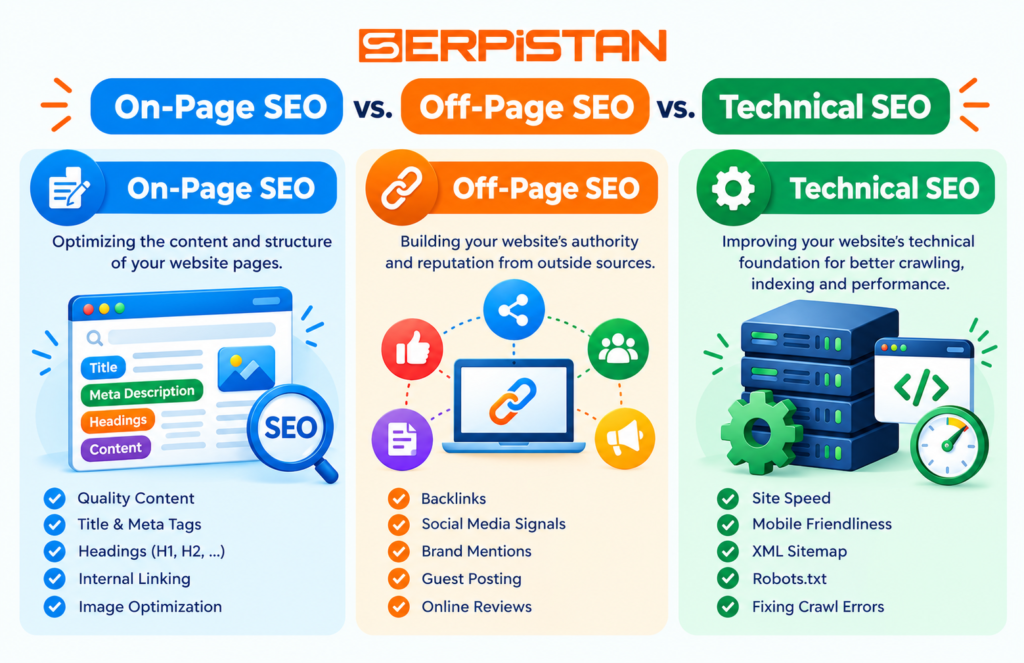
Quick Comparison: On-Page vs. Off-Page vs. Technical SEO
| SEO Area | What It Focuses On | Examples | Main Goal |
|---|---|---|---|
| On-page SEO | Content and page-level elements | Keywords, content, titles, headings, internal links | Help search engines and users understand page relevance |
| Off-page SEO | External signals and reputation | Relevant backlinks, mentions, digital PR | Build authority, reputation, and discoverability |
| Technical SEO | Website infrastructure | Crawling, indexing, canonicals, site architecture, performance | Make the site accessible and understandable to search engines |
What Is On-Page SEO?
On-page SEO is the process of improving the content and page-level elements of a website so that search engines and users can understand what the page is about and how well it satisfies the searcher’s intent.
On-page SEO is not simply inserting keywords into a page. It covers everything a visitor and a search engine encounter directly on a given page: the writing itself, the structure, the titles, the links to other pages, and the images. Done well, it’s less about pleasing an algorithm and more about making a page genuinely useful for the person reading it.
1. Search Intent
Before writing a single word, it helps to understand why someone is searching a given term in the first place. Search intent is usually grouped into a few categories:
- Informational intent: the searcher wants to learn something (“what is technical SEO”)
- Commercial investigation: the searcher is comparing options (“best SEO agency for small business”)
- Transactional intent: the searcher is ready to act (“hire SEO agency Lahore”)
- Navigational intent: the searcher wants a specific website or brand (“Serpistan login”)
- Local intent: the searcher wants something nearby (“SEO agency near me”)
A page built around the wrong intent often struggles to satisfy the searcher, even if it’s well written. The goal is to match the page to what the person actually needs, not just to contain the right keyword.
2. Content Quality and Relevance
Once intent is clear, the content itself needs to hold up: accuracy, originality, usefulness, and appropriate depth. Content written mainly to satisfy a word count or cram in keyword variations tends to read that way, and tends to underperform content written to genuinely help someone. Google’s own guidance on helpful content emphasizes creating content primarily for people, with first-hand knowledge and real expertise, rather than content created mainly to attract search traffic.
3. Title Tags
A title tag is the clickable headline that appears in search results and browser tabs. It should describe the page accurately, include the primary topic naturally, and give the searcher a reason to click. A keyword in the title does not guarantee rankings on its own, and a vague or keyword-stuffed title can hurt click-through rates even if the page ranks.
4. Meta Descriptions
A meta description is the short summary that often appears beneath the title in search results. It’s not a direct ranking factor, but it plays a real role in whether someone clicks your result over a competitor’s. A good one is relevant, clear, matches search intent, and gives an honest preview of what the page delivers.
5. Headings and Content Structure
H1, H2, and H3 headings create a logical hierarchy that helps both readers and search engines understand how a page is organized, making content easier to scan for anyone looking for a specific answer. They’re a structural aid, not a ranking formula; stuffing headings with keyword variations rarely helps.
6. Keyword Targeting
Modern keyword targeting looks less like repeating an exact phrase and more like covering a topic thoroughly: a primary keyword, related terms, underlying search intent, and the semantic relationships between concepts, using natural language rather than forced repetition. Keyword stuffing, exact-match repetition, and arbitrary keyword density targets make content harder to read without any corresponding ranking benefit.
7. Internal Linking
Internal links connect pages within your own website. They help users discover related content, establish relationships between pages, support overall site architecture, and help search engines understand which pages matter most, like a blog post about choosing an SEO agency linking to a services page, which links to a contact page, giving a reader a path from learning to acting.
8. Images and Media
Relevant images, descriptive alt text, and properly optimized file sizes all contribute to a better page experience and improved accessibility. Adding images alone does not guarantee better rankings; the goal is genuine usefulness and context, not simply hitting an image quota.
9. URLs
A useful URL is descriptive, concise, stable, and human-readable, giving both users and search engines a sense of what the page covers without clicking through. Established, already-indexed URLs shouldn’t be changed without good reason, since unnecessary changes can create redirect chains and lost signals.
10. Content Freshness
Updating content makes sense when the information has genuinely changed: statistics are outdated, a product or service has changed, regulations have shifted, or search intent around the topic has evolved. What doesn’t make sense is changing a published date simply to make old, unchanged content appear newer than it is.
What Is Off-Page SEO?
Off-page SEO refers to activities and signals outside your own website that can influence how your site is discovered, perceived, and understood in the broader web ecosystem.
Off-page SEO is broader than simply “building backlinks,” even though backlinks tend to dominate the conversation.
1. Backlinks
A backlink is a link from another website pointing to yours. Relevant, editorially earned backlinks from authoritative sources signal to search engines, and to readers, that other sites consider your content worth referencing. What matters is relevance and context, not raw volume; manipulative link-building practices tend to create real problems rather than real gains.
2. Digital PR
Digital PR involves earning media coverage, expert commentary opportunities, and mentions through genuinely newsworthy content, original research, or useful industry insights. Done well, it’s a way of earning legitimate links and visibility rather than a shortcut for manipulating rankings directly.
3. Brand Mentions
Not every mention of your brand online includes a link. Linked mentions, unlinked mentions, and general brand visibility all contribute to reputation in different ways. It’s an overstatement to claim every unlinked mention functions as a direct ranking factor, but broader brand visibility still carries real marketing value.
4. Online Reputation
Reviews, customer sentiment, and how your business is discussed by third parties shape how both users and search engines perceive your site, and how much this matters varies by business type and the kind of searches your customers run.
5. Local SEO Signals
Local SEO sits across multiple categories at once: on-site information, technical setup, and off-page signals like reviews, local citations, and locally relevant links. A consistent, accurate business profile across the web supports all of it.
Serpistan’s local SEO services focus specifically on helping businesses show up for nearby customers actively searching for their products or services.
6. Linkable Assets
Creating something genuinely worth referencing, original research, useful tools, calculators, or detailed case studies, tends to be more sustainable than manually chasing individual links, because these assets offer something that doesn’t already exist elsewhere.
What Is Technical SEO?
Technical SEO focuses on the technical structure and infrastructure of a website so search engines can efficiently crawl, understand, index, and access its content.
Technical SEO doesn’t mean “everything complicated about SEO.” It specifically concerns the technical conditions that support search visibility and usability, separate from the content itself or external signals.
1. Crawlability
Search engines discover URLs primarily through internal links, XML sitemaps, and by following links from other sites. Google describes a crawler as “a generic term for any program that is used to automatically discover and scan websites” (Google Search Central: Overview of Google crawlers ↗). Robots.txt can control which parts of a site crawlers are permitted to access, and Google’s crawlers “always respect robots.txt rules for automatic crawls.” That’s different from controlling whether a page gets indexed once it’s been crawled.
2. Indexability
A page being crawled doesn’t automatically mean it gets indexed. Noindex tags, canonicalization choices, duplicate URLs, and HTTP status codes all affect whether a page actually makes it into Google’s index. A page excluded from indexing, intentionally or by mistake, simply cannot perform in organic search, no matter how good its content is.
3. Site Architecture
A logical site structure, homepage to category pages to supporting content to product or service pages, helps both users and search engines find and understand important pages. Burying your most important pages several clicks deep makes them harder to discover and harder to prioritize.
4. Core Web Vitals and Page Experience
Core Web Vitals measure specific aspects of user experience: Largest Contentful Paint (loading speed), Interaction to Next Paint (responsiveness), and Cumulative Layout Shift (visual stability). Google states that “Core Web Vitals are used by our ranking systems” and that “Google’s core ranking systems look to reward content that provides a good page experience.” Mobile usability, HTTPS, and the absence of intrusive interstitials round out the broader page experience picture.
5. Mobile SEO
Responsive design, consistent content parity between mobile and desktop, usable navigation, and functional forms all matter here, particularly since most search traffic today happens on mobile devices.
6. Canonicalization
A canonical URL is “the URL of a page that Google chose as the most representative from a set of duplicate pages” (Google Search Central: Consolidate duplicate URLs ↗). Canonical tags help prevent duplicate or near-duplicate pages from confusing search engines about which version to show. Google’s own documentation describes a canonical preference as “a hint, not a rule,” meaning Google can choose a different version if it believes that serves users better, such as showing a mobile page to a mobile searcher even when the desktop page is marked canonical.
7. XML Sitemaps
An XML sitemap is “a file where you provide information about the pages, videos, and other files on your site, and the relationships between them,” which helps “search engines like Google read this file to crawl your site more efficiently” (Google Search Central: Sitemaps overview ↗). A sitemap should contain the correct canonical URLs. It is not a guarantee: “a sitemap helps search engines discover URLs on your site, but it doesn’t guarantee that all the items in your sitemap will be crawled and indexed.”
8. Structured Data
Structured data is “a standardized format for providing information about a page and classifying the page content” (Google Search Central: Intro to structured data ↗). It can make a page eligible for enhanced search features like rich results, but eligibility isn’t the same as a guarantee. Pages must include all required properties to even be considered, and structured data on its own does not produce a universal ranking boost.
On-Page vs. Off-Page vs. Technical SEO: The Key Differences
On-page SEO answers the question: “Is this page relevant and useful for what the searcher wants?” It focuses on content, search intent, keywords, titles, headings, and internal links.
Off-page SEO answers the question: “How does this website fit into the broader web, and what external signals support its authority and reputation?” It focuses on relevant backlinks, digital PR, mentions, and reputation.
Technical SEO answers the question: “Can search engines efficiently access, understand, and process this website?” It focuses on crawling, indexing, architecture, performance, and canonicalization.
How the Three Types of SEO Work Together
Imagine a local accounting firm publishes a guide targeting “how much does an accountant cost.”
On the on-page side, the firm understands the search intent behind that question, writes a genuinely useful guide, structures it with clear headings, targets relevant related terms, and links to its accounting services page.
On the technical side, the website loads quickly, works well on mobile, is fully crawlable and indexable, and sits within a logical site architecture that makes the guide easy to find.
On the off-page side, the guide eventually earns links from reputable business publications and gets referenced by industry websites, building the firm’s broader authority over time.
None of these three pieces does the whole job alone. The strongest result comes from all three supporting each other.
Which Type of SEO Should You Prioritize First?
It’s tempting to jump straight to link building, since backlinks often get the most attention in SEO conversations. In practice, a more useful order looks like this.
First, fix critical technical problems. Important pages that aren’t indexed, major crawl errors, broken site architecture, incorrect canonicals, and serious mobile usability issues undermine everything else. There’s little point optimizing content or chasing links for a page Google can’t properly access.
Second, improve high-value on-page content. Focus on search intent, core service or product pages, existing content with untapped potential, content gaps, and clear paths to conversion.
Third, build external authority. Once your site has content genuinely worth referencing, invest in digital PR, relevant backlinks, industry relationships, and linkable assets.
This is a practical prioritization model based on what tends to produce results efficiently, not an official hierarchy from Google.
Can You Do SEO Without Backlinks?
Yes, to a point. A website can earn meaningful organic visibility without an aggressive link-building campaign, particularly when competition is low, the content is highly relevant, search demand is specific, or the business already has topical relevance and some existing authority.
That said, external authority tends to become more important as competition increases. Backlinks aren’t either completely essential or completely irrelevant; how much they matter depends heavily on the competitiveness of your specific market.
Can You Do SEO Without Technical SEO?
Not really, even if you don’t think of yourself as “doing technical SEO.” Every website has a technical foundation, whether anyone has paid attention to it or not. Indexing problems, broken site architecture, slow or unusable pages, incorrect canonicalization, and major crawl barriers can undermine otherwise strong content and real external authority. Technical issues tend to cap how well everything else performs.
Can You Do SEO Without On-Page SEO?
No. External links and solid technical infrastructure can’t compensate for a page that doesn’t actually satisfy what the searcher came looking for. The content still has to serve the person reading it; technical access and outside authority just mean more people are able to find it once it does.
Common SEO Mistakes When Choosing Between the Three
Mistake 1: Focusing only on keywords. Keywords without genuine search intent and useful content behind them rarely hold up over time.
Mistake 2: Buying backlinks before fixing the website. External authority can’t solve fundamental technical or content problems, and manipulative link practices carry their own risks.
Mistake 3: Treating technical SEO as a one-time project. Technical conditions change as a website grows, gets redesigned, or adds new content, so this needs ongoing attention rather than a single audit.
Mistake 4: Publishing content without internal links. Content that isn’t connected to the rest of the website becomes harder for both users and search engines to discover and contextualize.
Mistake 5: Measuring SEO only by rankings. Traffic, leads, conversions, revenue, and overall search visibility all matter more than ranking position for any single keyword.
Mistake 6: Treating all three areas as separate departments. The strongest SEO strategies coordinate on-page, off-page, and technical work rather than running them in isolation.
A Simple SEO Audit Framework
On-page audit: Does each important page satisfy a clear search intent? Is the content useful and accurate? Are titles and headings descriptive? Are important pages internally linked? Are commercial pages properly optimized?
Off-page audit: Does the website have relevant external links? Are referring domains reputable? Does the brand have industry visibility? Are there realistic opportunities for digital PR? Does the website have content worth referencing?
Technical audit: Can important pages be crawled? Can they be indexed? Are canonical signals correct? Is the site architecture logical? Does the website work well on mobile? Are performance issues affecting usability?
On-Page vs. Off-Page vs. Technical SEO Checklist
On-Page SEO
- Search intent identified
- Useful content created
- Primary topic clearly covered
- Titles optimized
- Headings structured logically
- Internal links added
- Images optimized
- Important pages connected to conversion paths
Off-Page SEO
- Relevant backlinks evaluated
- Toxic or manipulative link practices avoided
- Digital PR opportunities identified
- Brand reputation monitored
- Industry mentions pursued where appropriate
- Linkable assets created
Technical SEO
- Important pages crawlable
- Important pages indexable
- Canonicals reviewed
- XML sitemap maintained
- Site architecture logical
- Mobile experience functional
- Core Web Vitals monitored
- Structured data implemented where appropriate
How Serpistan Can Help
Understanding the difference between on-page, off-page, and technical SEO is useful, but figuring out which of these areas actually needs attention on your specific website is a different task entirely. Serpistan works across all three: SEO audits, on-page content optimization, technical SEO fixes, and local SEO for businesses that depend on nearby customers.
If you want a clearer picture of which SEO problems matter most for your site and how the different pieces fit together, Serpistan’s SEO services can help you prioritize, and real examples of past client work are available in our case studies.
Frequently Asked Questions
What is the difference between on-page and off-page SEO?
On-page SEO focuses on the website itself, content, titles, headings, and internal links, while off-page SEO focuses on external signals and reputation, such as backlinks, mentions, and digital PR.
What is the difference between technical SEO and on-page SEO?
Technical SEO focuses primarily on website infrastructure: crawling, indexing, architecture, and technical accessibility. On-page SEO focuses more directly on page content and page-level relevance to a search query.
Which is more important, on-page or off-page SEO?
Neither one universally wins. Both can contribute meaningfully to organic performance, and their relative priority depends on the specific website, its competition, and its current weaknesses.
Is technical SEO more important than content?
Critical technical problems can prevent otherwise strong content from performing at all, but a technically flawless website still needs useful, relevant content to succeed. Neither one is sufficient without the other.
Do backlinks still matter for SEO?
Relevant, reputable external links can still support authority and discoverability. Quantity alone doesn’t determine rankings; relevance and context matter more than raw link counts.
Can I do on-page SEO myself?
Many basic on-page improvements, like writing clearer titles or organizing content with proper headings, can be implemented internally. Larger websites or more competitive markets may benefit from professional support to prioritize effectively.
How often should technical SEO be done?
Technical SEO should be monitored on an ongoing basis, with deeper audits performed periodically or whenever a site undergoes significant changes, such as a redesign or migration.
What are the three main types of SEO?
On-page, off-page, and technical SEO are commonly used categories for organizing SEO work, though they aren’t an official classification system from Google itself.
Is local SEO on-page or off-page?
Local SEO spans multiple areas at once, including on-site optimization, technical setup, business information accuracy, reviews, and local links, which is part of why it’s often treated as its own specialty.