
COMPARISON
11 MIN READ
A website can look visually impressive and still perform poorly. It can also function technically well while giving visitors a confusing, frustrating experience. Both problems trace back to the same common confusion: treating web design and web development as interchangeable terms, when they’re actually two distinct disciplines that happen to work closely together.
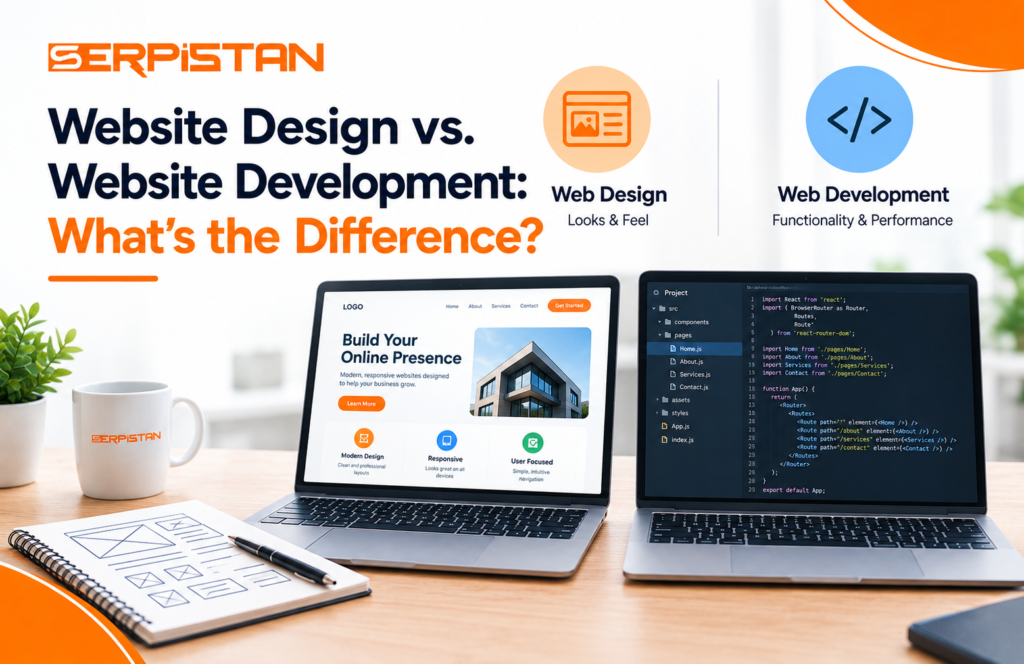
The simplest distinction: web design focuses primarily on how a website looks, feels, and guides users. Web development focuses primarily on how the website is built, functions, and works technically. Neither one replaces the other, and most professional website projects, in the comparison of web design vs web development, need both to succeed.
This guide breaks down what each discipline actually involves, where they overlap, what skills each requires, and how to think about which one (or both) your project needs.
Web Design vs. Web Development at a Glance
| Factor | Web Design | Web Development |
|---|---|---|
| Primary focus | Visual experience and user interaction | Technical functionality and implementation |
| Main question | How should the website look and feel? | How should the website work? |
| Common responsibilities | Layout, typography, colors, UX, visual hierarchy | Front-end, back-end, databases, integrations |
| Typical tools | Design tools like Figma, design systems | HTML, CSS, JavaScript, frameworks, CMS platforms |
| Main outcome | Design system and user experience | Functional website |
| Collaboration | Works with developers and stakeholders | Works with designers and stakeholders |
Actual responsibilities vary by agency, project, and individual role. A small team might blend these functions; a larger project might split them across several specialists.
What Is Web Design?
Web design is the process of planning and creating the visual and interactive experience of a website: how it looks, how it’s organized, and how people move through it. It covers layout, color, typography, visual hierarchy, navigation, user experience (UX), user interface (UI), responsive layouts, calls to action, content presentation, and brand consistency.
Good web design is not simply about making a website look attractive. It should help users find information, understand the offer, navigate the website without confusion, complete important actions like filling out a form or making a purchase, build trust in the business, and use the website comfortably across devices, including phones and tablets.
What Does a Web Designer Do?
User Experience Design
UX design focuses on how a website is structured and how people move through it: information architecture (how content is organized), navigation, user flows (the path someone takes to complete a task), page hierarchy, and conversion paths.
User Interface Design
UI design focuses on the visual and interactive elements people see and touch: typography, colors, buttons, forms, cards, spacing, and other visual components that make up the interface.
Responsive Design
Designers plan experiences that work across desktop, tablet, and mobile, since the same layout rarely works identically at every screen size. Responsive design means planning how content reflows, resizes, and reorganizes as the screen changes.
Wireframes and Prototypes
Wireframes are simplified structural sketches of a page, showing layout without visual detail. Mockups add visual design to that structure. Interactive prototypes let stakeholders click through a simulated version of the site before development begins. Design systems document the reusable components, colors, and typography rules a team applies consistently across a project. Tools like Figma are commonly used for this work, though they’re one example among several, not a requirement of the discipline itself.
What Is Web Development?
Web development is the technical process of building and maintaining the functionality of a website. It can include writing code, implementing designs, building interactive functionality, managing databases, connecting APIs (application programming interfaces, which let different systems exchange data), integrating third-party systems, creating content management functionality, improving performance, implementing security measures, and maintaining and updating the website over time.
Development responsibilities vary significantly depending on the type and complexity of the website. A simple brochure site needs far less development work than an e-commerce platform or a custom web application.
What Does a Web Developer Do?
Front-End Development
Front-end development focuses on the parts of a website users interact with directly, what renders in the browser. Common technologies include HTML (which structures content), CSS (which styles it), JavaScript (which adds interactivity), and front-end frameworks where appropriate for the project. Front-end development is essentially the process of turning a visual design into a functional browser experience: the buttons click, the menus open, the layout adjusts to the screen.
Back-End Development
Back-end development deals with server-side functionality, the parts users don’t see directly but that make the website work. A server is the computer that stores a website’s code and sends it to a visitor’s browser when requested. Potential back-end responsibilities include databases (where information like user accounts or product listings is stored), authentication (verifying who a user is), business logic (the rules that govern how the system behaves), APIs, other server-side processes, and data management. A simple example: when someone submits a contact form, back-end code is what actually receives that submission, stores it, and may trigger an email notification.
Full-Stack Development
Full-stack developers can work across both front-end and back-end components. That doesn’t mean one person should necessarily handle every aspect of a website project; “full-stack” describes a skill range, not a guarantee that a single person is the right fit for every project’s scope or complexity.
Web Design vs. Web Development: Key Differences
| Area | Web Design | Web Development |
|---|---|---|
| Primary concern | User experience and interface | Technical functionality |
| Visual appearance | Core responsibility | Implementation responsibility |
| User flows | Plans and designs | Implements |
| Code | May have limited involvement | Core component |
| Databases | Usually not primary responsibility | Often relevant to back-end work |
| Responsive behavior | Designs responsive layouts | Implements responsive behavior |
| Performance | Considers performance implications | Implements technical optimizations |
| Accessibility | Plans accessible experience | Implements accessible code and behavior |
| Integrations | Defines user-facing requirements | Connects technical systems |
| Testing | Usability and visual testing | Functional and technical testing |
These responsibilities overlap in practice more than a table can fully capture. A designer who understands technical constraints produces more realistic designs, and a developer who understands design intent builds a more faithful final product.
How Web Design and Development Work Together
Successful website projects usually require collaboration between both disciplines, typically following a process like this: research, information architecture, wireframes, visual design, development, testing, launch, and optimization.
1. Research. Understand the business goals, target audience, competitors, user needs, and conversion goals before designing or building anything.
2. Information architecture. Organize pages, navigation, content, and the user journeys that connect them.
3. Wireframes. Create the basic structure of important pages before investing in visual polish.
4. Visual design. Develop the visual system and interface based on the approved structure.
5. Development. Turn the approved design into a functional website, building out the front-end and back-end as the project requires.
6. Testing. Check functionality, responsive behavior, forms, links, performance, accessibility, and browser compatibility.
7. Launch and optimization. Monitor the website after launch and make improvements based on real-world performance rather than assumptions made before launch.
Why Both Design and Development Matter
The core principle: design determines how users experience the website, and development makes that experience technically possible and reliable. One without the other produces a website that fails somewhere, even if it succeeds somewhere else.
Is Web Design or Web Development More Important?
Neither discipline is universally more important; it depends on what the specific project needs. A visually complex brand website may require significant design work relative to its development needs. A web application may require extensive development work relative to its design needs. A simple informational website may need relatively straightforward development. A conversion-focused business website typically needs both a clear user experience and reliable technical implementation in roughly equal measure.
The more useful question isn’t which discipline matters more. It’s what the project requires to achieve its business and user goals, which will differ from one website to the next.
Can One Person Do Both Web Design and Development?
Yes. Freelancers, full-stack professionals, small agencies, and larger multidisciplinary teams all take different approaches to covering both disciplines, each with trade-offs.
One person handling both tends to offer simpler communication, fewer handoffs between people, and potentially lower coordination overhead on smaller projects. The trade-offs are limited specialization in either discipline, capacity constraints on larger projects, and typically less depth in each specialized area compared to a dedicated specialist.
A specialized team tends to offer deeper expertise in each discipline, dedicated design and development skills applied to their respective parts of the project, and better support for complex projects with many moving parts. The trade-offs are more coordination required between people and potentially higher project cost.
Neither model is universally better; the right choice depends on project complexity, budget, and timeline.
Do You Need Both Web Design and Web Development?
| Project Type | Design Needs | Development Needs |
|---|---|---|
| Basic business website | Moderate | Moderate |
| Marketing website | High | Moderate to high |
| E-commerce website | High | High |
| Web application | High | Very high |
| Portfolio website | High | Low to moderate |
| Content-heavy website | Moderate to high | Moderate |
| Custom platform | High | Very high |
Complexity varies substantially even within each category. Two “basic business websites” can have very different actual requirements depending on the number of pages, the integrations needed, and the level of customization the business wants.
Web Designer vs. Web Developer: Which Professional Should You Hire?
Consider a web designer when: you need a new visual direction, your website looks outdated, navigation is confusing, brand presentation needs improvement, or the user experience needs restructuring.
Consider a web developer when: the website has technical problems, new features need to be built, integrations are required, performance needs technical optimization, or the site requires custom functionality.
Consider both when: building a new business website, redesigning and rebuilding an existing website, creating an e-commerce platform, building a complex website or web application, or when the website plays a major role in lead generation or sales for the business.
Questions to Ask a Web Design or Development Agency
- Who handles the design?
- Who handles development?
- What CMS (content management system) or technology will be used?
- Is the website responsive?
- How will SEO be considered during development?
- How will accessibility be addressed?
- How will performance be tested?
- Who owns the website and its assets once the project is complete?
- What happens after launch?
- Is ongoing maintenance available?
- How are revisions handled?
- How are integrations and third-party tools managed?
Understanding exactly what’s included in a project’s scope before signing on avoids a common source of frustration: discovering midway through that something you assumed was included, like SEO setup or post-launch support, actually wasn’t.
How Web Design and Development Affect SEO
Both disciplines influence SEO (search engine optimization), though in different ways.
Design considerations include navigation (can both users and search engines find their way around), content hierarchy, mobile usability, readability, and overall user experience.
Development considerations include site speed, crawlability (can search engines access and read the site), technical structure, responsive implementation, structured data where appropriate, canonical implementation (telling search engines which version of a page is the authoritative one), redirects, and indexability.
Site speed in particular ties design and development together directly. Google’s Core Web Vitals framework measures loading (Largest Contentful Paint, ideally within 2.5 seconds), interactivity (Interaction to Next Paint, ideally 200 milliseconds or less), and visual stability (Cumulative Layout Shift, ideally 0.1 or less), and states that “optimizing for quality of user experience is key to the long-term success of any site on the web” (web.dev: Web Vitals ↗). A heavy, image-dense design can undermine even well-written code if it isn’t implemented with performance in mind.
Visual design alone doesn’t determine search rankings, and neither does clean code alone; SEO should be considered during both design and development rather than treated as something added after the site is already built.
How Web Design and Development Affect Conversions
Design shapes user experience, which shapes trust, which shapes whether someone takes action. Development shapes performance and functionality, which shapes whether the conversion path actually works reliably once someone tries to use it.
In practice, that means clear CTA (call to action) design, simple forms, fast-loading pages, a mobile-friendly checkout, easy navigation, visible trust signals, and contact forms that actually function and deliver their submissions. Conversion performance depends on many factors beyond design or development alone, including the offer itself, the audience, pricing, and market conditions, so neither discipline can guarantee conversion results on its own.
When Should You Consider Professional Web Design and Development?
Professional support can be useful when the existing website is outdated, the business is losing leads because of poor user experience, the website is difficult to maintain internally, custom functionality is required, the business is launching a new brand or service, e-commerce functionality is needed, the website needs a complete redesign and rebuild, or internal teams don’t have the technical expertise the project requires.
Serpistan’s web design and development services cover both sides of this work, from the visual experience through the technical build. Need a website that looks professional and works reliably? Serpistan can help with both the design experience and the technical development needed to turn it into a functional business asset. This isn’t a promise of guaranteed rankings, conversions, speed improvements, or revenue; results depend on the project’s scope, the market, and ongoing execution after launch.
Serpistan’s SEO services and digital marketing services can also support a website once it’s built, and case studies show examples of past project work.
Frequently Asked Questions
What is the difference between web design and web development?
Web design focuses on how a website looks, feels, and guides users through visual and interactive experience. Web development focuses on how the website is built and functions technically, through code, databases, and system integrations. Most professional websites need both.
Is web design easier than web development?
Neither is inherently easier; they require different skill sets, and the complexity of each depends heavily on the specific project. A highly custom design can be just as demanding as a complex development build, and vice versa.
Does a web designer need to know coding?
It varies by role and workflow. Some designers work primarily in visual design tools and hand off their work to developers. Others have front-end development skills and can implement some or all of their own designs.
Does web development include design?
Developers often contribute to implementation details and technical decisions that affect the final look and behavior of a site, but visual design is frequently handled separately, especially on larger or more design-driven projects.
Can a web developer design a website?
Some developers have strong design skills and can handle both; others specialize primarily in development and work best alongside a dedicated designer. It depends on the individual, not the job title alone.
Do small businesses need both a web designer and developer?
It depends on the website’s scope, complexity, budget, and internal capabilities. A simple site might need relatively light involvement from both; a more ambitious project usually benefits from dedicated attention to each discipline.
What is front-end web development?
Front-end development is the part of building a website that happens in the browser: the HTML, CSS, and JavaScript that control what users see and interact with directly.
What is back-end web development?
Back-end development is the server-side part of a website: databases, authentication, business logic, and the systems that process and store data behind the scenes, out of the user’s direct view.
How much does web design and development cost?
Cost varies based on scope, number of pages, functionality, integrations, CMS choice, e-commerce requirements, customization, content needs, and overall project complexity. Because these factors differ so much by business and market, this guide won’t publish a universal price range; a specific quote should come from a provider after reviewing your actual requirements.
Final Thoughts
Web design and web development aren’t competing disciplines, and treating the comparison, web design vs web development, as a question of which one to choose usually sets a project up incorrectly from the start. Design determines how a website looks, feels, and guides people through it. Development determines whether that experience actually works, loads quickly, and holds up technically. Most business websites need real attention to both, in proportions that depend on the specific project, not a fixed formula.