
EXPLAINER
13 MIN READ
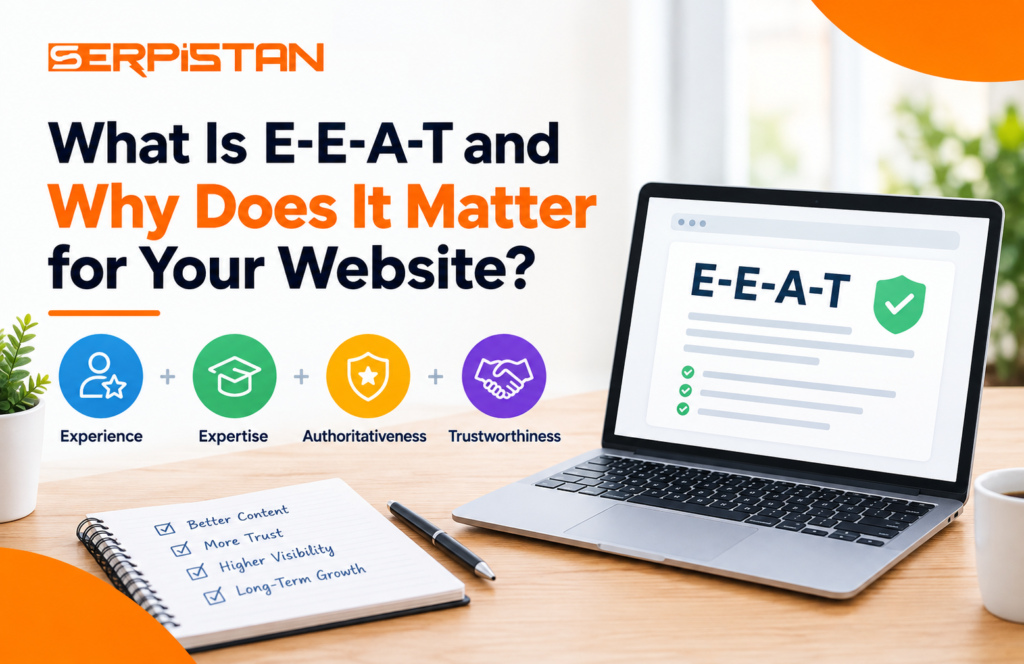
E-E-A-T stands for Experience, Expertise, Authoritativeness, and Trustworthiness. Google uses these concepts in its guidance for evaluating whether content demonstrates the qualities of helpful, reliable information, and the term comes up constantly in SEO discussions without a clear explanation of what it means for your website.
Google’s SEO Starter Guide goes further, listing “Thinking E-E-A-T is a ranking factor” under things you shouldn’t focus on, with the blunt clarification: “No, it’s not” (Google Search Central: SEO Starter Guide ↗).
Automated systems use a mix of signals that can identify aspects of E-E-A-T, and raters use E-E-A-T concepts to evaluate search results and give feedback on whether Google’s systems are working well. Neither process means a website can “increase its E-E-A-T score,” because no such single score exists.
This guide explains what each part of E-E-A-T means and what website owners can realistically do to demonstrate them.
What Does E-E-A-T Stand For?
| Letter | Meaning | What It Represents |
|---|---|---|
| E | Experience | First-hand involvement or experience with the subject |
| E | Expertise | Knowledge and skill related to the topic |
| A | Authoritativeness | Recognition or credibility of the creator, content, or website |
| T | Trustworthiness | Accuracy, transparency, reliability, and credibility |
These concepts overlap rather than operating as four separate checkboxes: first-hand experience can strengthen credibility, and transparent sourcing can contribute to trust. A website doesn’t need a perfect score in all four categories; it needs content that genuinely reflects these qualities where they’re relevant.
What Is the Difference Between E-A-T and E-E-A-T?
E-A-T originally referred to Expertise, Authoritativeness, and Trustworthiness, concepts that have appeared in Google’s quality rater guidelines for years. Google later added Experience, creating E-E-A-T, with an update to its quality rater guidelines in December 2022 described in a Google Search Central blog post titled “Our latest update to the quality rater guidelines: E-A-T gets an extra E for Experience.”
The additional “E” doesn’t mean expertise became less important; it means Google’s framework now distinguishes more clearly between knowing something through formal expertise and being able to credibly discuss something because you’ve directly experienced it. A doctor writing about a medical condition demonstrates expertise. A patient describing what it was like to actually live with that condition demonstrates experience. Both can be valuable, depending on the content’s purpose.
The Four Parts of E-E-A-T Explained
| Experience First-hand knowledge |
Expertise Relevant knowledge or skill |
Authoritativeness Recognized credibility |
Trustworthiness Accuracy and transparency |
1. Experience
Experience concerns the extent to which content demonstrates appropriate first-hand experience with the topic. Google’s guidance notes that “some content might be helpful based on the experience it demonstrates,” and for product reviews, suggests considering “the number of products that were tested, what the test results were, and how the tests were conducted” (Google Search Central: Creating helpful content ↗).
Examples include a product reviewer who actually used the product, a business owner explaining lessons learned from running a business, or a travel writer describing a place they personally visited. Not every topic requires first-hand experience; a reference article explaining a scientific concept may rely more on expertise. What matters is that experience is never fabricated, since claiming first-hand experience an author or business doesn’t actually have undermines the trust the whole framework is meant to support.
2. Expertise
Expertise refers to relevant knowledge or skill. This can include professional knowledge, specialized training, demonstrated knowledge built through practice, subject-matter experience, and author credentials where they’re actually relevant to the topic.
Expertise doesn’t always require formal qualifications. For some subjects, practical knowledge or demonstrated competence matters more than academic credentials; a self-taught woodworker with decades of hands-on experience can offer real expertise on furniture-making without a certification. For medical or legal topics, formal credentials tend to carry more weight because the stakes of getting it wrong are higher. What matters is that the expertise is genuine; implying credentials that don’t exist undermines trust rather than building it.
3. Authoritativeness
Authoritativeness concerns how credible and recognized the creator, content, or website is for the topic at hand. Potential signals include accurate and useful content, relevant credentials, a strong reputation, independent references from other credible sources, industry recognition, high-quality citations, and a website with a clear topical focus.
Authority is contextual: a website can be highly authoritative about one specific topic without being authoritative about everything it publishes. A well-regarded nutrition blog isn’t automatically authoritative on tax law just because it has a strong reputation in its own niche.
4. Trustworthiness
Google’s own guidance identifies trust as the most important of the four concepts: “trust is most important. The others contribute to trust, but content doesn’t necessarily have to demonstrate all of them” (Google Search Central: Creating helpful content ↗).
Trust can be supported by accurate information, transparent authorship, clear business and contact information, reliable sources, and corrections when errors are discovered. It matters most when inaccurate information could significantly affect people’s health, finances, safety, or well-being, covered in more detail below, where Google gives stronger weight to strong E-E-A-T.
Why Does E-E-A-T Matter for SEO?
It’s not accurate to say “Google gives websites an E-E-A-T score.” It’s more accurate to say E-E-A-T concepts align with Google’s broader goal of surfacing helpful, reliable, people-first content, which its guidance frames as aiming “to present helpful, reliable information that’s primarily created to benefit people, not to gain search engine rankings” (Google Search Central: Creating helpful content ↗).
In practice, E-E-A-T principles can encourage websites to create genuinely useful content, demonstrate real knowledge rather than surface-level summaries, cite credible sources, provide transparent authorship, and add original insight the reader can’t get anywhere else. None of this is about gaming a hidden score; it’s about producing content that holds up when a knowledgeable person, or a search quality rater, looks closely at it.
Does E-E-A-T Directly Affect Google Rankings?
Search quality raters play a related but separate role. Google describes these as a group of more than 10,000 people worldwide who evaluate search results against published guidelines, explicitly noting that “this rating does not directly impact how this page or site ranks in Search. Nobody is deciding that any given source is ‘authoritative’ or ‘trustworthy.’” (Google: How insights from people around the world make Google Search better ↗). Rater feedback is aggregated to help Google evaluate its systems, not used directly as a ranking signal for any individual page.
How to Improve E-E-A-T on Your Website
1. Show Who Created the Content
Google’s guidance asks: “Is it self-evident to your visitors who authored your content?” and recommends that pages “carry a byline, where one might be expected,” leading “to further information about the author or authors involved, giving background about them” (Google Search Central: Creating helpful content ↗).
Where appropriate, this can include an author name, a relevant biography, a dedicated author page, and relevant credentials. Google explicitly warns against “fabricating creator profiles (such as by using AI-generated headshots, made-up names, or false credentials),” which it treats as a sign of low-quality, search-engine-first content rather than genuine trust-building.
2. Demonstrate First-Hand Experience
Where genuinely relevant, add real evidence of experience: original photographs, case studies, a description of your testing methodology, or lessons learned from actual work. Don’t manufacture experience or dress up a generic summary as first-hand knowledge; readers and raters alike tend to notice when “experience” is really just paraphrased research.
3. Cite Reliable Sources
Appropriate external references can strengthen credibility when they’re used to support specific claims rather than just make an article look well-researched. Useful source types include government agencies, academic institutions, official documentation, and recognized subject-matter authorities. A citation should answer a specific question the reader has, not simply sit in the article as decoration.
4. Add Original Value
Google’s guidance encourages content that provides “original information, reporting, research, or analysis” rather than simply copying or rewriting what already exists elsewhere. This can take the form of original examples, expert commentary, data analysis, or practical experience the reader won’t find in five other articles covering the same subject.
5. Keep Content Accurate and Updated
Factual accuracy matters on an ongoing basis, not just at publication. Review claims periodically, update outdated information, and correct errors when found.
6. Make Your Business Information Transparent
For commercial websites, useful trust-building elements include an about page, contact information, accurate service descriptions, and a privacy policy. None of these is confirmed as a direct Google ranking signal on its own; think of them as ways to improve transparency and user trust rather than boxes to check for search engines specifically.
7. Make Important Claims Verifiable
Readers should be able to understand where important information comes from. Source citations, author credentials, and a described methodology all help with this, and it matters most for consequential topics where getting something wrong carries real consequences for the reader.
E-E-A-T and YMYL Topics
Your Money or Your Life (YMYL) is Google’s term for topics that can significantly affect people’s health, financial stability, safety, or broader well-being. Google’s guidance states: “our systems give even more weight to content that aligns with strong E-E-A-T for topics that could significantly impact the health, financial stability, or safety of people, or the welfare or well-being of society. We call these ‘Your Money or Your Life’ topics, or YMYL for short” (Google Search Central: Creating helpful content ↗).
Examples of YMYL topics include health information, financial guidance, legal information, and safety-related information, where inaccurate content could lead someone to make a decision that genuinely harms them. That said, E-E-A-T principles aren’t exclusive to YMYL content; a recipe blog still benefits from real experience and trustworthy information, even though the consequences of getting something wrong are generally lower than for medical or financial advice.
E-E-A-T Examples by Website Type
| Website Type | Experience | Expertise | Authority | Trust |
|---|---|---|---|---|
| Medical website | Practitioner or patient experience where appropriate | Qualified medical knowledge | Recognized medical expertise | Accurate, transparent information |
| Financial website | Relevant practical experience | Financial expertise | Credible sources and reputation | Clear disclosures and accurate claims |
| E-commerce site | Product testing or customer experience | Product knowledge | Brand credibility | Accurate product information and policies |
| SaaS website | Product implementation experience | Technical and product expertise | Industry knowledge | Transparent pricing, support, and claims |
| Marketing agency | Campaign experience and case studies | Marketing expertise | Relevant industry credibility | Transparent services and evidence |
These are illustrative examples of how the four concepts might show up for different businesses, not mandatory requirements that guarantee a particular outcome.
E-E-A-T Checklist for Website Owners
Experience
- Does the content demonstrate genuine first-hand experience where relevant?
- Are case studies based on real work?
Expertise
- Is the author qualified or knowledgeable about the subject?
- Is relevant author information available?
- Are technical claims accurate?
Authoritativeness
- Is the website clearly focused on relevant topics?
- Are credible sources referenced?
- Is the organization or author identifiable?
Trustworthiness
- Are claims accurate and sources transparent?
- Is authorship clear?
- Is business or contact information available where appropriate?
- Are errors corrected when identified?
Common E-E-A-T Mistakes to Avoid
Adding author bios without real expertise. A bio alone doesn’t demonstrate genuine knowledge; it only works if the person behind it actually has the background it describes.
Citing sources without adding value. References should support meaningful claims, not simply decorate the page to look more credible than the underlying writing actually is.
Rewriting existing articles without original insight. Google’s guidance specifically encourages original value and additional information over content that mainly restates what’s already published elsewhere.
Publishing AI-generated content without meaningful oversight. The focus should stay on usefulness, accuracy, and originality, since Google’s guidance discusses AI-assisted content in terms of how it was created and whether automation is being used primarily to manipulate rankings, not whether AI was involved at all.
E-E-A-T vs. Other SEO Factors
E-E-A-T doesn’t replace fundamental SEO work; it sits alongside it.
| Area | Main Purpose |
|---|---|
| E-E-A-T | Demonstrate qualities associated with experience, expertise, authority, and trust |
| Technical SEO | Help search engines crawl, understand, and access the site |
| Search intent | Align content with what users are looking for |
| On-page SEO | Help communicate topic and relevance |
| Content quality | Provide useful, accurate, satisfying information |
| Page experience | Provide a usable overall experience |
Google recommends focusing on people-first content rather than obsessing over any single isolated metric, E-E-A-T included.
E-E-A-T and AI-Generated Content
AI can assist with content production, but it does not automatically demonstrate experience or expertise simply by producing fluent text. Human review tends to be necessary for accuracy and nuance, and original research or first-hand knowledge should never be fabricated, whether a human or a tool is doing the writing.
Google’s guidance asks publishers to consider the “Who, How, and Why” of their content: who created it, how it was produced (including whether automation was involved, and whether that’s disclosed), and why it exists, calling “why” “perhaps the most important” of the three (Google Search Central: Creating helpful content ↗).
It’s not accurate to claim that Google automatically penalizes every AI-generated article, nor that human-written content automatically has stronger E-E-A-T than AI-assisted content. What matters is whether the finished content is accurate, original, and genuinely useful, regardless of which tools were involved in producing it.
How Serpistan Can Help Improve Your Website’s SEO
Serpistan can help businesses evaluate content quality, technical SEO, author and content transparency, and organic search opportunities as part of a broader SEO and digital marketing strategy, rather than as an isolated “E-E-A-T optimization service,” since no such narrow service actually matches how Google’s systems work.
Want to know whether your website is giving users and search engines enough reason to trust your content? Serpistan can help audit your SEO and identify practical opportunities to strengthen it. Case studies show examples of past work; this isn’t a promise of guaranteed rankings, but a structured look at where your content currently stands.
Frequently Asked Questions
What does E-E-A-T stand for in SEO?
E-E-A-T stands for Experience, Expertise, Authoritativeness, and Trustworthiness, concepts Google uses to evaluate whether content demonstrates the qualities of helpful, reliable information.
Is E-E-A-T a Google ranking factor?
No. Google states directly that E-E-A-T itself is not a specific ranking factor; its systems instead use a mix of factors and signals that can identify content with qualities associated with strong E-E-A-T.
How do I improve E-E-A-T?
Demonstrate genuine first-hand experience where it’s relevant, provide accurate and well-sourced information, identify who created the content, add original value rather than rehashing existing content, and build trust through transparency and corrections when errors occur.
What is the difference between E-A-T and E-E-A-T?
E-A-T originally covered Expertise, Authoritativeness, and Trustworthiness. Google added Experience in a December 2022 update to its quality rater guidelines, to better account for first-hand knowledge alongside formal expertise.
Does E-E-A-T matter for every website?
The underlying principles, accuracy, transparency, and trust, are broadly useful for any website. Google places even more emphasis on strong E-E-A-T specifically for YMYL topics that can significantly affect people’s health, financial stability, safety, or well-being.
Does E-E-A-T directly improve rankings?
Not directly. E-E-A-T is a concept, not a ranking signal itself. Google’s various ranking systems use a mix of factors and signals that can identify E-E-A-T-related qualities, and improving those underlying qualities tends to support the broader goal of ranking systems: surfacing helpful, reliable, people-first content.
Does adding an author bio improve E-E-A-T?
Accurate authorship information can help users understand who created the content and can support trust when the bio reflects real, relevant background. It doesn’t guarantee stronger search performance on its own; it’s one piece of a larger picture that includes the accuracy and usefulness of the content itself.
Final Thoughts
E-E-A-T is a useful lens for thinking about whether your content genuinely reflects experience, expertise, authority, and trust, not a score to chase. Google has been clear that E-E-A-T itself isn’t a ranking factor, that trust matters most among the four concepts, and that its systems rely on a mix of signals rather than one measurement. The most reliable way to act on it is also the simplest: create content that’s accurate, transparent about who made it and why, and honest about what you actually know and have experienced.