
GUIDE
10 MIN READ
If you run a medical practice, clinic, or healthcare brand and have just started SEO, one question comes up quickly: when will this start bringing in patients?
The honest answer is that it depends, but not in a vague way. Medical SEO follows a fairly predictable pattern, and the factors that make it faster or slower are well understood. This guide explains the realistic timeline, why healthcare SEO often takes longer than SEO in other industries, what you should see at each stage, and how to tell whether progress is on track.
What Google Says About SEO Timelines
Google’s Search Central documentation, in its guidance on hiring an SEO, says that in most cases SEOs need four months to a year to help a business first implement improvements and then see potential benefit. That range applies to all industries, and healthcare sites often land toward the longer end for the reasons below.
For a general explanation of SEO timelines across industries, see our guide to how long SEO takes. This article focuses on what is different for medical and healthcare websites.
Why Medical SEO Can Take Longer
Health content is held to a higher standard
Google treats health topics as “Your Money or Your Life” content, where inaccurate information could harm someone. Its quality guidelines place extra weight on experience, expertise, authoritativeness, and trust for these pages. Building those signals, such as clinician-reviewed content, clear author credentials, and a trusted reputation, takes time. Our guide to E-E-A-T explains these signals.
Content needs clinical review
Medical pages should be written or reviewed by qualified clinicians. Review cycles add time to every page you publish, so content programs in healthcare usually move more slowly than in other industries.
Competition is strong
In most US cities, dentists, dermatologists, orthopedic practices, and med spas compete with hospital systems, large practice groups, and national directories such as Healthgrades and Zocdoc, as well as major health publishers. Outranking established sites for broad terms takes sustained effort.
Compliance limits some tactics
Patient privacy rules affect how you collect and respond to reviews, use testimonials, and publish before-and-after photos. Doing these things properly is the right approach, but it can slow down tactics that other businesses use freely.
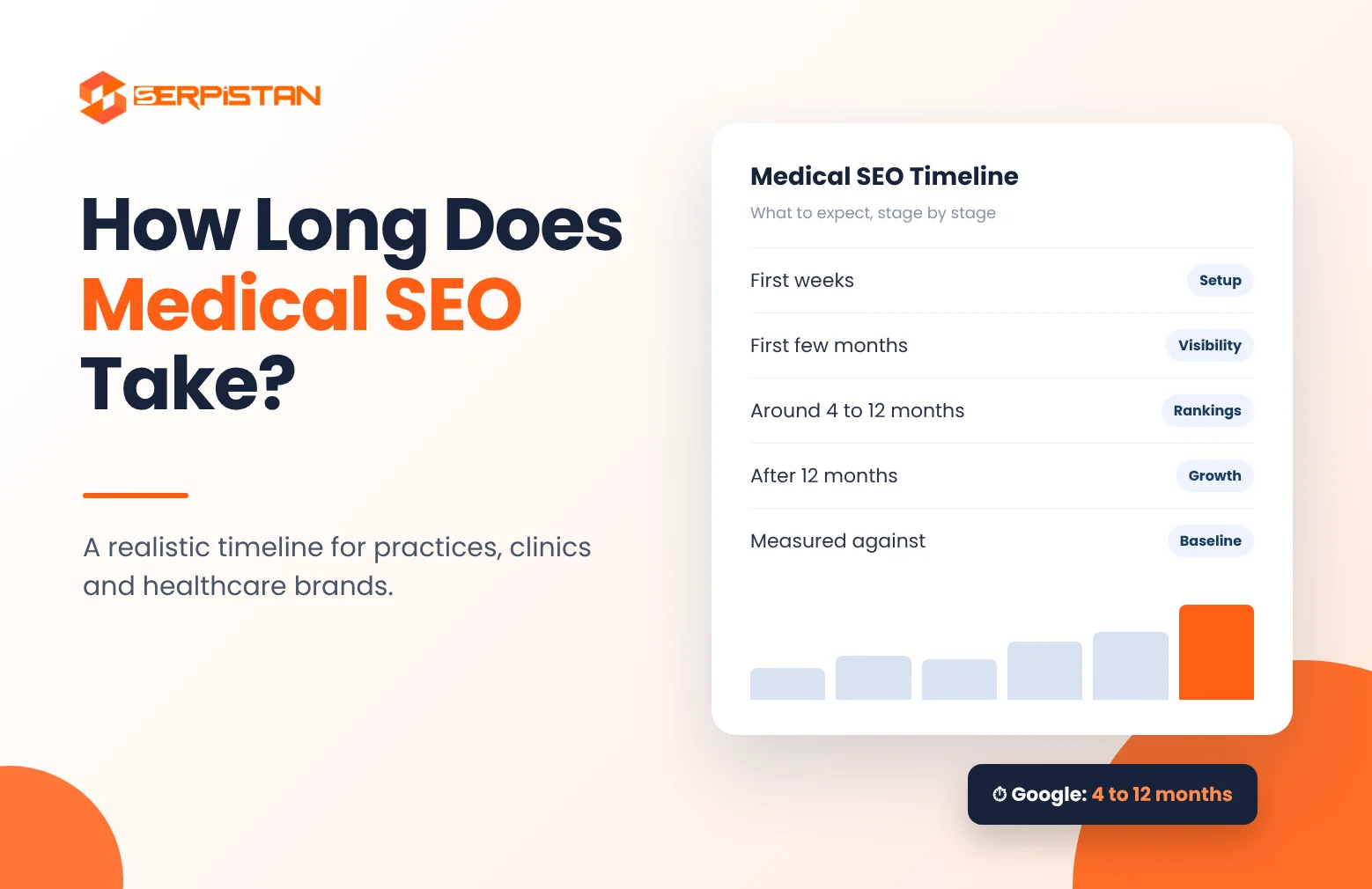
A Realistic Medical SEO Timeline
Every practice is different, but most healthcare SEO campaigns move through the same stages:
| Stage | What happens | What you should see |
|---|---|---|
| First weeks | Baseline, tracking setup, technical audit, Google Business Profile and listing fixes | A clear starting point, working conversion tracking, corrected profiles |
| First few months | Service, condition, and location pages improved or created; technical issues fixed; review program started | More pages indexed, rising impressions in Search Console, early movement in local map results |
| Around 4 to 12 months | Content depth grows, reviews accumulate, links and mentions build up | Higher rankings for treatment and condition searches, more organic calls, bookings, and form submissions |
| After 12 months | Ongoing content, reputation, and technical maintenance | Compounding growth and stronger positions for competitive terms |
Impressions usually rise before clicks, and clicks before appointments. Seeing impressions increase in the first months is a normal, positive sign, even if patient numbers have not moved yet.
Factors That Make Medical SEO Faster or Slower
| Usually faster | Usually slower |
|---|---|
| Established website with some existing authority | Brand-new domain or recent rebrand |
| Smaller town or less competitive specialty | Large metro or highly competitive specialty |
| Complete, accurate Google Business Profile | Duplicate, unverified, or suspended profiles |
| Steady flow of patient reviews | Few or old reviews |
| Clinician-reviewed, detailed service pages | Thin pages or one generic services page |
| Fast, mobile-friendly site with clean tracking | Slow site, technical errors, or broken tracking |
| Consistent work every month | Stop-start effort or frequent strategy changes |
Local SEO Usually Moves First
For most practices, the quickest gains come from local search: the map results that appear for searches such as “dermatologist near me” or “urgent care in [city].” Fixing the Google Business Profile, categories, services, photos, and listings, and building a steady flow of reviews, often improves map visibility before organic website rankings move. See our guide to what local SEO is, and for a specialty example, our guide to local SEO for dermatologists.
How to Tell Whether Medical SEO Is Working
Do not judge progress by rankings alone. Record where you started with an SEO baseline report, then look for these signals in order:
- Technical health: important pages indexed and errors resolved.
- Visibility: impressions growing in Google Search Console, especially for non-branded searches.
- Local actions: more calls, direction requests, and website clicks from Google Business Profile.
- Rankings: priority service and condition pages moving up.
- Patients: more organic appointment requests, calls, and bookings.
If none of these is moving after several months, it is worth asking harder questions. Our guide on how to tell if your SEO agency is actually working lists what to check.
How to Speed Up Medical SEO Safely
- Fix tracking first so you can see which pages and listings bring in patients.
- Prioritize the services that bring the most value, and give each its own detailed page.
- Complete and verify the Google Business Profile for the practice and each eligible provider.
- Ask every satisfied patient for a review, and reply without disclosing patient information.
- Have a clinician review every medical page and show their name and credentials.
- Fix technical issues that block crawling, indexing, or mobile usability; an SEO website audit will show where they are.
- Build local links and mentions from medical associations, hospitals, community groups, and local media.
Medical SEO Support for Practices and Agencies
SERPISTAN helps US healthcare practices, and the agencies that serve them, with local SEO, service and location pages, technical SEO, and transparent reporting. Agencies can use our white label SEO services to deliver this work under their own brand.
Frequently Asked Questions
How long does it take for medical SEO to work?
Medical SEO usually takes several months to produce meaningful results. Google says SEO generally needs four months to a year to implement improvements and see their benefit, and healthcare sites often take longer than average because health content is held to higher quality standards.
Why does SEO take longer for medical practices?
Health topics are treated as Your Money or Your Life content, so Google gives extra weight to expertise and trust. Medical content also needs clinical review, competition from hospital systems and national directories is strong, and patient privacy rules limit some tactics.
What results should I see in the first three months of medical SEO?
Early signs usually include fixed technical issues, more pages indexed, growing impressions in Google Search Console, and improvements in Google Maps visibility after the Business Profile and listings are fixed. Increases in appointments typically come later.
Does local SEO work faster than regular SEO for doctors?
Often, yes. Fixing the Google Business Profile, listings, and reviews can improve map visibility before organic website rankings move, especially in less competitive areas.
Can a medical SEO agency guarantee results?
No. Google states that no one can guarantee a number one ranking. A reliable agency will explain its strategy, set realistic expectations, and report on visibility, calls, and bookings against a clear baseline.
1 comment